Hello everyone,
The tale of two technological revolutions.
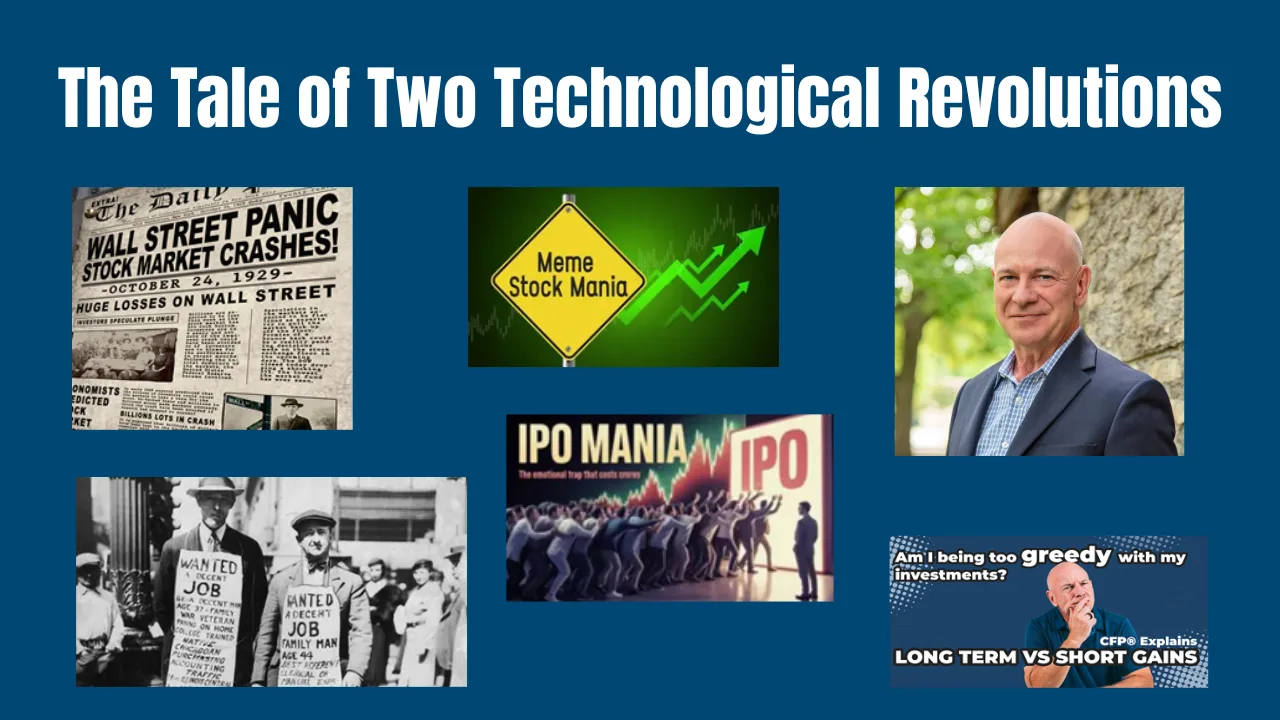
Americans who lived through the Great Depression remained forever watchful for the next economic meltdown that was sure to reappear at some point in the near future. Banks would fail (despite new government guarantees and protections), the stock market would crash, and unemployment would soar above 20% once again. Every slight economic downturn or pullback in the stock market was greeted with a sense of inevitability. Here we go again. I knew it.
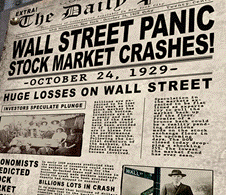
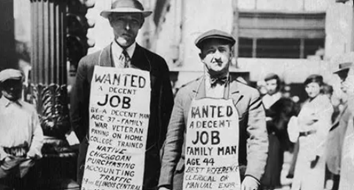
As I’ve mentioned before, when I started my career in the financial advisory business more than a few years ago, I had elderly clients who were young adults during the 1930s. Their angst and apprehension about investing in the stock market was ever present. Their experiences were something I had to be aware of when recommending investments and designing portfolios. Their allocation looked decidedly different from the more traditional portfolios I constructed for the rest of my book of business. This wasn’t true for everyone, but certainly for most Depression-era clients.
Although not as extreme, the twin bear markets of the 2000s (internet and housing bubbles) left similar scars on investors who survived that Lost Decade. We still live with remnants of it to this day, investors treating every major bull market as a “bubble.” The financial media doesn’t help, tossing around the bubble word in ubiquitous fashion, like folks on a parade float tossing out trinkets and candy to kids and their watchful parents. It’s too bad because the fearmongering keeps too many investors on the sidelines, particularly those who lived through the 2000s. The scars are real.
We’ve definitely had mini bubbles since the Great Financial Crisis of the late 2000s. The meme-stock mania of 2021 comes to mind.


Bubbles aren’t always easy to spot but that one certainly was. Seriously, you didn’t need an advanced degree in finance to recognize that market conditions were just a tad out of whack. You just needed a modicum amount of common sense, a little knowledge of market history, and an understanding of human greed. Those traits would’ve kept any serious investor out of the likes of GameStop, AMC Theaters, and others. No surprise they all crashed.
That brings us to the here and now, replete with all the warnings of an AI-fueled bubble. Man, this is getting old. It’s been going on for several years and these bearish analysts and commentators just won’t give it up. They don’t even try to hide their disdain for the huge runup in tech stocks in recent years. They can’t use the acronym “AI” without including the word “bubble.” The “AI bubble” this, the “AI bubble” that. They’ve been dead wrong from the beginning of this four-year bull run, and I believe they’re dead wrong still today.
There are numerous reasons why I believe we are not close to the kind of classic bubble that defined, say, the Internet boom of the late 1990s. Allow me to highlight a few of the most obvious ones.
*Initial Public Offerings. Nothing defines the internet era of the late 1990s quite like the proliferation of the “hot” IPO. Tell investment banks and private investors that you had an idea of selling a product on the Internet and millions of dollars were sure to flow your way. “What do you mean you won’t turn profitable for many years to come? Don’t worry about it! Who do I make the check out to?!”


Nothing of the sort is happening today. Indeed, quite the opposite. Using just one high-profile example, Wall Street has been waiting to cash in (maybe) on an Anthropic IPO but the company keeps pushing it off. They cite “market conditions,” which is code for “investment banks are questioning our business model and nervous about our profit-making ability.”
Other high-profile companies that decided to go public have suffered. Coreweave is just one example. The cloud-computing company manages complex AI infrastructure and was considered a must-have IPO. It hit the market in early 2025, the stock more than tripling in its first several months of trading. It has since plummeted 65% and is back near its initial trading price. This simply did not happen in 1999 at the peak of the internet bubble, at least not as frequently as it is today.
*Valuations. In March 2000, the forward P/E ratio of the tech-heavy Nasdaq 100 was 65. Today it sits at 28.59, which is just a smidge above its long-term average of 27.8. The poster child of the AI revolution, Nvidia, sports a trailing P/E of 27.3 and a future estimated ratio of 17.9. The internet’s darling was Cisco Systems, which carried a P/E ratio of about 200! And we’re supposedly in a similar tech/AI bubble today? C’mon. One could reasonably argue that today’s highfliers aren’t necessarily undervalued, especially if earnings start to fall short in 2027. But you lose all credibility, in my opinion, if you’re throwing around the “bubble” word today.
*Economic conditions. The economy of the late 90s was hot, hot, hot. It gave investors the green light to go all in, to eschew caution and embrace greed. The University of Michigan’s Consumer Sentiment Index remained above 100 during most of the internet craze, peaking at 112 in January 2000. And today? It sits at 51.7 after dipping to an all-time low of 44.8 back in May.
Let’s look at a couple of additional data points that show the difference between then and now.
GDP Growth Inflation
1996 3.6% 3.0%
1997 4.5% 2.3%
1998 4.5% 1.6%
1999 4.9% 2.2%
2023 2.9% 4.1%
2024 2.8% 2.9%
2025 2.1% 2.6%
2026* 1.6%-2.2% 3.7%
(*estimated)
Economic growth in the late 1990s was historically strong and growing. Today’s it’s weakening. Inflation back then was contained. As far as today, we’re well aware of inflation rising once again.
The point here is Investors today are weary of the war, inflation, and how AI might affect their jobs. These factors help keep any kind of market bubble from inflating.
Please understand when I opine that we’re not in a classic bubble, I am NOT suggesting it’s up, up, and away from here. Quite the contrary. We’re currently undergoing a pullback in the techies, and a very healthy one at that. I say bring it on. It keeps investors honest and the market in check. So yes, we might see a continued repricing in stocks in the near term. We might even see a down year in 2027. But the odds of an outright crash, the kind that saw the Nasdaq plummet 78% from 2000-02, remain quite low in my humble opinion.
Odds and Ends:
a. Could the stock market ascend to record highs before the end of the year? And what would be the driving force behind it? Any number of things. But the easy answer, the most obvious one, is a blowout earnings season that is now underway. After posting an incredible 49.9% jump in profit growth in the second quarter, more than twice what was expected, S&P 500 companies are now projected to show a 24.3% increase in earnings for the recently completed third quarter. Most of that, of course, is being fueled by the technology sector. But Wall Street is also expecting big gains from the energy and materials sectors.
With that said, the stock market is unlikely to get a boost by earnings merely meeting expectations. Like the second quarter, we’re going to need a slew of high-profile companies exceeding estimates by a wide margin. More importantly, company execs need to raise estimates for future quarters, giving Wall Street the thumbs up that economic conditions remain favorable for continued growth. Anything less than that and we could see 2026 close with a thud.
b. My wife and I recently vacationed in Switzerland for the first time. Wow, wow, wow. Absolutely stunning. And absolutely expensive! You think there’s money floating around in the U.S. Take a trip to Lake Lucerne. There’s rich, and then there’s rich. So I was not surprised to come across the following upon our return trip last week.
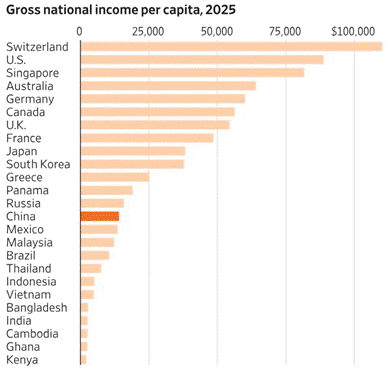
Source: Wall Street Journal, 10-14-26
(The Journal story from where I found this graph highlighted China’s economy, thus the darker bar.)
The average Swiss citizen brings home the equivalent of about $115,000 annually, far surpassing every other country in the world. It would be tempting to think that the cost of living in Switzerland is so much higher than everywhere else so the extra income disappears quickly. Somewhat true…to a point. Here’s the annual “cost of living index” put together every year by the World Population Review.

Switzerland is indeed first, but is tied with the U.S. So indeed, the Swiss get a little big more bang for the buck as it were. No wonder the country is also near the top every year in “Happiest Countries in the World.”
c. As the old saying goes, “real estate is all about location, location, location.” That’s true on the local level, and it’s certainly true on a national level. Take a look at the following map and focus on the colors more than the individual state home prices. You’ll see a clear delineation between the high average prices out west and in the New England area, and the more moderate prices in the heart of the U.S.
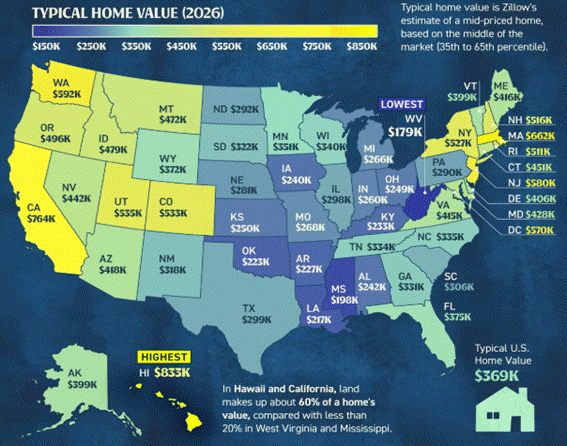
Source: Visual Capitalist, 10-9-26
Hawaii and California, not surprisingly, are the two priciest states in the Union for average home prices. And it’s not even close. On the other end, West Virginia and Mississippi post the lowest average prices, both under $200k.
Home sales last month rose 1.5% but that uptrend could be short-lived. September sales reflected contracts that were written in July and August when mortgage rates leveled off around 6.5%. The average 30-year rate has since jumped to about 7.4%. That could put a freeze on home sales until rates start falling. When that happens is anyone’s guess.
I’ve talked about the need for investors to put the blinders on during periods of market extremes. Unfortunately, many investors unknowingly put on a third blinder. They place it right in front of their eyes, losing sight of their long-term goals. I call it “myopic investing,” and it can prove costly to one’s future plans. I explore the subject in this week’s Simons Says podcast, using real life stories from veteran advisors I befriended many years ago. Please check it out!
Myopic Investing: The Costly Mistake Investors Make in Market Extremes

Have a great weekend everyone, and GO MIZZOU! Tough one on the road this week at #9 Ole Miss. I don’t know if we’ll win but we’ve certainly had their number over the years. The Tigers are 7-1 all time against the Rebels, including a 38-27 win the last time they met in 2019.
M-I-Z…
Dave