Hello everyone,
- Memories of 25 years ago.
“Did you hear about this?”
That’s the question Tom Cordes posed to me as I walked into the office early on the morning of Tuesday, September 11, 2001. Exactly 25 years ago today.
Tom was pointing at the small TV on his desk. The North Tower of the World Trade Center was billowing smoke about 95 floors up. Supposedly a small plane had crashed into it. How could that happen? It was a clear day in New York City, a bright blue sky with nary a cloud. We just assumed that the pilot had a medical emergency. Maybe he passed out. Or, God forbid, did he do it on purpose? Who really knew. It was just all very strange.
I then walked into my office and turned on the TV there. I looked at some emails, did a little research, and kept a side eye on the TV for further developments. The fire and smoke seemed to be spreading to other floors. Man, oh man. I sure hope people are able to get out of there, I thought.
And then it happened. Minutes later the South Tower was struck by a second airplane. I was actually staring at the TV when the impact occurred, horrified to watch a fireball explode between the 77th and 85th floors. And that’s when I knew. When we ALL knew. We were under attack.
My wife and I had just visited the towers four months earlier. We even had dinner one night at “Windows on the World,” a restaurant atop the North Tower. All 170 people in the restaurant that morning of 9/11, including 72 employees, perished. Many of them died before the tower fell because of smoke inhalation. It was confirmed that five employees jumped to their deaths. I think of the people who waited on us. Could they have been there the morning of September 11?
I think of 32-year-old Richard Salandardi of Hoboken, New Jersey. I knew him a decade earlier as Richie from St. Louis, his hometown. He interned for us in the sports department at KMOV. A good looking and personal young man, I knew he was going to make it in whatever field he chose. He eventually married and moved to New York City where he became the general manager of a food company. His office was high atop the South Tower. When the North Tower was first hit, many folks started evacuating from the south one, including some of Richie’s employees. Witnesses later confirmed that he yielded to others crowding into the elevator, saying he’d catch the next one. It never came. The second plane soon hit the South Tower, trapping everyone above the 78th floor. Richie’s remains were later identified through DNA testing.
We all have our “where were you stories” of that horrific day a quarter century ago. I gave you a brief description of where I was, and the initial complacency I felt after the first crash. But minutes later, after the second plane hit, I found myself looking out the window of our three-story office building in Chesterfield. Would I possibly see a plane heading toward the Arch? Could these terrorists, whoever they are, burst into the Chesterfield Mall next door and start massacring people? I’m almost embarrassed to admit to these thoughts today. But as we were getting additional reports of more planes being hijacked and flown into other areas (the Pentagon, an open field in Pennsylvania), it was all too much for a rational mind to accept. My brain went wild with all kinds of doomsday scenarios. And that wouldn’t end for weeks. Even months.
You may recall that the stock market remained closed for the rest of that week, and wouldn’t reopen until the following Monday, September 17. The debate wasn’t if stocks would open significantly lower, but by how much. Sure enough, the market cratered as soon as the opening bell rang out, plunging 684 points, equating to a 7.1% loss. It was the most points the Dow had ever dropped in one day at the time. By the end of the week the Dow had fallen 14%, the S&P 500 dropped 11.6%, and the tech-heavy Nasdaq plummeted 16%. An estimated $1.4 trillion in market value was lost that week. Cue the usual fearmongering that the U.S. was heading toward another Great Depression…or worse. Turns out that the S&P rallied sharply after that first week and returned to pre-9/11 levels within a month.
However, the U.S. economy was already on a slippery slope before September 11. What most people forget is that we were already in a recession before that day, the S&P down 21.6% from its all-time high. The popping of the speculative dot-com bubble, along with a fall in business spending and investments, officially caused the U.S. economy to contract in March 2001. Interestingly enough, the recession was declared over in November of that year, just two months after 9/11. Yes, the stock market continued to suffer sizeable losses in 2002, but that was due to the after-effects of the Internet frenzy coming to an inglorious end. The economy itself had already begun healing. It’s a lesson we should all remember. The economy and stock market aren’t the same thing and can drift apart for months at a time.
Perhaps our adversaries thought an attack on our soil that left nearly 3,000 people dead would crush our spirits. Perhaps they assumed we’d cower to some degree, seeking to make peace with those who attacked us. Big mistake. The same that the Japanese made 60 years earlier. After the attack on Pearl Harbor, Japanese Admiral Isoroku Yamamoto knew something that his superiors back home would never understand. America’s resolve, its ability to come together during times of existential threats. “I fear all we have done is awaken a sleeping giant,” remarked Yamamoto, “and fill him with a terrible resolve.”
Over the past 25 years, the U.S. economy and stock market have boomed to heights no other developed country comes close to matching. Our GDP has risen by 207%, while more impressively the S&P 500 has rocketed 640% higher. But there is one negative outcome that was birthed in the aftermath of September 11. We got used to cheap money and extended benefits, something we’re grappling with to this day.
It sounds quaint now but we were actually running budget surpluses leading up 9/11. Tax reform, tighter controls on spending, and the economic boom of the Internet lead to four consecutive years of budget surpluses from 1998-2001. That shows up in the green bars in the following slide of our annual deficit/surplus numbers since 1970.
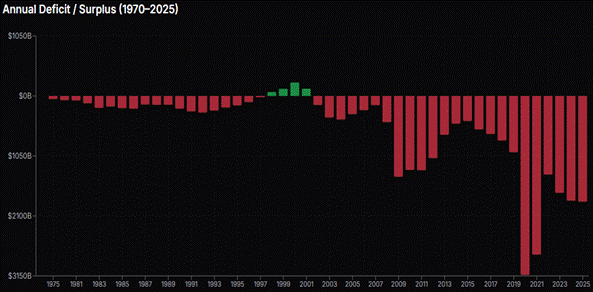
Source: us-debt-clock.com
You can see how the government posted record annual deficits immediately after 2001. But now those years look like nothing more than a speed bump to what lay ahead. The Great Recession brought even larger deficits. That was completely understandable at the time. There were legitimate fears that the economy was about to crash to Depression-like levels. Next up, the pandemic-era lockdown. Again, understandable why we needed deficit spending for a year or two. But we’re now back to running annual deficits in the trillions?! Shaking my head. (SMH, as the cool kids would write.) This is occurring when the economy is growing and tax revenues are booming. Simply unfathomable.
That gets us to the here and now. Our annual deficits have pushed our country’s overall debt level to above $40 trillion. Bond traders are finally taking this development seriously, all while inflation has stayed above the Fed’s 2% stated target. Just this morning, the August inflation report (CPI) showed that inflation rose 0.4% for the month and 3.4% from 12 months before. Those numbers were exactly in line with expectations and both the stock and bond markets rallied after the number was released. You might say it’s a bit of a “whew” relief rally that the inflation report didn’t come in hotter.
This was the last inflation-related report before the Fed meets next week, the announcement on interest rates coming Wednesday at 1 p.m. Central. The betting markets now place the odds of a rate hike at 90%. We’ll see. As I stated previously, I’m not so sure that Warsh and Company need to jack up rates based purely on economic reasons, but they certainly need to do so to maintain credibility with the bond market.
And that’s where I’ll end it, my friends. No Odds and Ends this week. I had written them but it just didn’t feel right with the somber tone of this week’s message. You’ll notice I also didn’t include any pictures, outside of the slide on deficits. We’ve seen enough 9/11 visuals to last a lifetime. And we’re being reminded of it again today wherever we turn. The usual format returns next Friday.
If you want to watch something a little lighter this weekend, I urge you to check out the latest Simons Says podcast. I reveal a few quirky things in my past that help me to segue into a discussion on shorting stocks. Something about spending a night in jail? Really?! You’ll have to check it out to see the connection.
What Is Short Selling? The Risk That Could Bankrupt Investors
Make it a safe and enjoyable weekend. We’ll talk to you next week.
Dave