Hello everyone,
- Buy the dip! It works…until it doesn’t.
There’s an investment strategy out there that has worked every single time it’s been tried since 2009. I’m not kidding. Every…single…time.
I’m talking about “buy the dip,” a rather ubiquitous phrase that investors have simply taken for granted. You simply dive into the market with both feet after the market has dipped a few percentage points. The lack of a major bear market, the kind that crushes the souls of investors, has given the investing public a sense of invincibility for nearly two decades. But just remember…
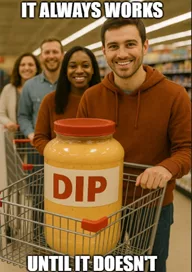
When the strategy finally fails, I guarantee those folks won’t be smiling. Unless they’re properly diversified, of course, while taking a little risk off the table.
Let’s review the classic “Cycle of Investor Emotions.” After surviving the after-effects of the Great Financial Crisis (2007-09), we’ve pretty much been living on the left half of this slide.
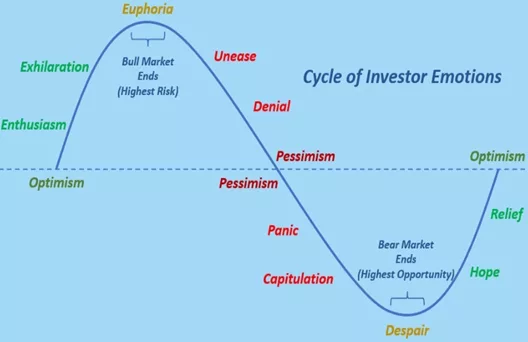
The closest we got to widespread panic and capitulation was in the spring of 2020 when the global economy shut down. The S&P crashed 35% in just five weeks and quite a few investors were cashing out. But it wasn’t widespread. The majority of investors gritted their teeth and held on tight. Good call. Those who went a step farther and bought into the weakness (“buy the dip”) were handsomely rewarded.
Where are we today? Most investors are on either side of the “Euphoric” top. Some folks are quite optimistic about our economic prospects and would plant themselves somewhere along that far left line, but not yet at the tippy-top euphoric stage. Others may have slipped down to the “unease” part of the trendline. That’s just their nature to begin with. No judgment here. We’re all wired differently.
I will say this. Any market strategist, or regular investor for that matter, who is predicting a major crash has to be engaging in a special kind of mental gymnastics to reach that conclusion. They’d have to be generally bearish to begin with, and then find the data that supports their position. Bulls can do that too, of course. There are plenty of economic talking points on which to build a case either way. But a major crash that approaches the five major bears that have occurred over the past 60 years? The odds aren’t zero, of course, but c’mon. Economic and market conditions don’t hint at any reasonable possibility of a major meltdown like the Fab Five of previous bear markets:
1968-70 (-36.1%)
1973-74 (-48.2%)
Fall of 1987 (-33.5%)
2000-02 (-49.1%)
2007-09 (-56.8%)
(Notice I’m not including the spring of 2020, which I consider an anomaly.)
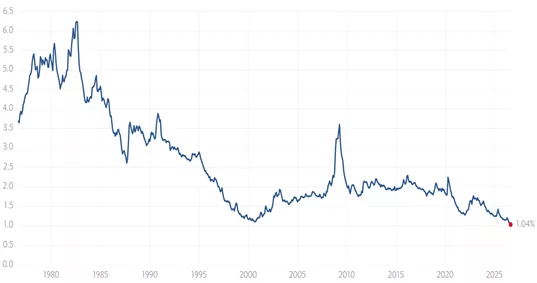
I don’t want to appear pollyannish, as if we have clear sailing as far as the eye can see. I think you all know me better than that. I’m always talking about the possibility of sharp corrections at any time. Indeed, there’s the occasional warning sign that flashes across our computer screens. Margin debt is one. (Brandon and I are about to record a YouTube podcast on that very topic.) The drop in the dividend yield of the S&P is another, as this chart shows.
Dividend Yield of S&P 500 (since 1975)
Source: Multiple.com, 8-10-26
Investors are receiving a miniscule yield of just 1.04% when buying a fund that tracks the index. That, my friends, is an all-time low. This is what happens when stocks are soaring at a faster rate than companies are hiking their dividends. You can see the last time we were at these low levels. 2000. Uh oh.
But one data point does not a bear market make. As I’ve been opining, I have every reason to give this bull market the benefit of the doubt. Meantime, many investors will continue to “buy the dip” as we enter the next major bear market. Unfortunately, no one rings a bell to tell you this is THE ONE. They’ll simply keep throwing good money after bad. It’ll be a hard habit to break. But eventually they’ll reluctantly admit….
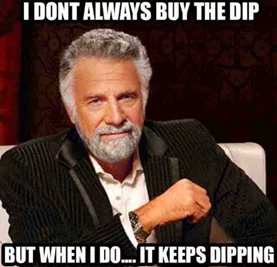
My opinion, and that’s all it is—a professional opinion, is that we’ll eventually suffer through the painful hangover of the AI explosion. But we’re nowhere close to that today. Carry on!
- Odds and Ends
- The Fed continues to receive less-than-robust economic data, possibly giving Fed members an excuse to keep short-term interest rates right where they are. The jobs report, existing homes sales, the producer price index, and this week’s inflation number all show an economy that is inching along but far from a rapid pace. I don’t know about the end of the year, but I don’t believe the Fed will touch rates at its next meeting in mid-September. We’ll get one more report on both inflation and jobs before that meeting, and those numbers should strongly hint at the Fed’s direction in the last quarter of 2026.
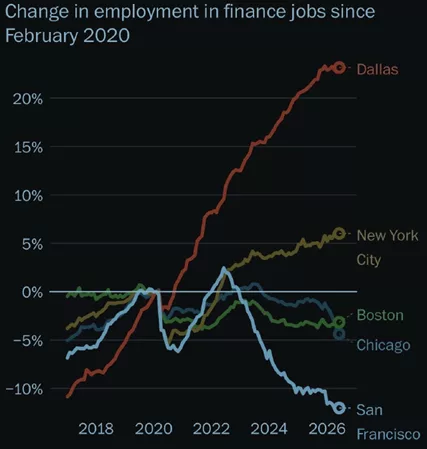
- It’s nice to see that the financial corner of New York City has slowly risen from the ashes post-Covid. No comment on how the city’s current political climate may affect Wall Street’s fortunes down the road, but for now the trendline continues to move higher from its nadir five years ago. A healthy New York City is good for all of us, at least from an investment perspective.
But holy moly, look at the meteoric rise in Dallas in financial-related jobs. As you may have heard, the new Texas Stock Exchange opened a couple of weeks ago in Dallas.
Source: Federal Reserve Bank of Dallas
I don’t see Dallas suddenly overtaking Wall Street, at least not in my lifetime. There’s plenty of business to go around for everyone.
By the way, did you notice the dropoff in San Francisco? So sad, and completely preventable. Implement bad policies and you inevitably get bad results. No more complicated than that.
- Speaking of economic policies, take a look at the difference in GDP growth between the U.S. and Canada over the past decade. Double holy moly!
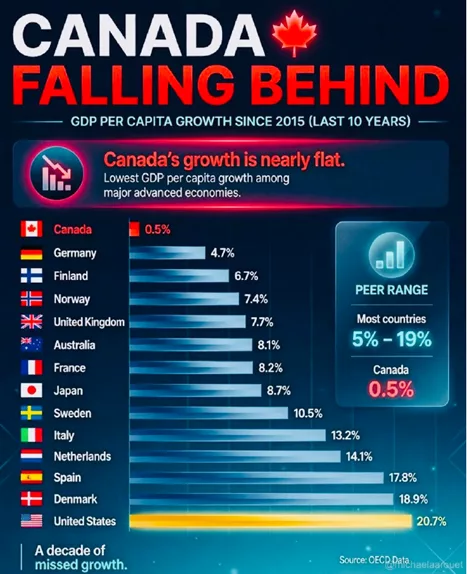
I know there’s growing dissatisfaction among many Americans right now, especially with the younger crowd. I don’t dismiss their concerns, and you shouldn’t either. The inability to buy their first home, something my wife and I were able to afford in our late 20s, is just one legitimate complaint. But my goodness, pure unadulterated socialism is not the answer. I don’t have the bandwidth to begin a deep dive into the matter, but I shouldn’t have to. A modicum amount of critical thinking, and an unbiased look at world history, will give you all the answers you need. And that’s my soapbox comment of the week.
Some recent developments have required me to update some prior podcasts. Please click the link here to see if I’ve changed my mind of any of them.
Kevin Warsh, Trump Accounts & the AI Bubble: What Investors Need to Know
I revisit the potential of an AI bubble in the stock market, if the Trump accounts are a good long-term investment for newborns, and whether Kevin Warsh is his own man or nothing more than a puppet for the Prez. Please take a look!
That’s it from here. Make it a great weekend and we’ll talk again next Friday!
Dave