One of the more interesting stories to emerge from Wall Street is the subject of today’s commentary. To do the tale justice, I have to spend a little extra time detailing its finer points. That means no “Odds and Ends” this week. Sorry about that! But I think you’ll enjoy the story and how it may explain the market’s violent reactions in July, particularly the sharp correction and equally sharp rebound in high-flying tech stocks.
Enjoy!
—————————————————
Hello everyone,
- Brains and brawn are no match for Mr. Market.
So…um….was that it? The minor speed bump in July, that’s all we’re getting for a correction?
Maybe so, especially if a theory making the rounds on Wall Street is the reason behind the pullback to begin with.
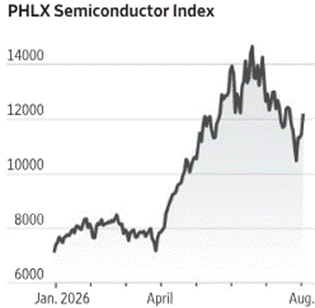
To explore this, let’s go back a couple of months. While the broader market was holding its own, most AI-related stocks came crashing back to earth after hitting a peak in mid-June. I had been writing on these pages that I’d welcome a decent-sized correction in that corner of the market, which frankly was more a wish than a prediction. Sure enough, we got the pullback and then some as some stocks (think computer chips) got cut in half in a matter of weeks.
Source: Wall Street Journal, 8-5-26
That move to the upside from early April to mid-June is quite impressive. And that’s not just one stock. That’s an entire index of equities tied to the semiconductor industry, 33 in all. You can see why I was hoping Mr. Market would intervene. Those kinds of exponential moves are what bubbles are made of. Let’s NOT party like it’s 1999, okay?!
Thankfully, large institutional players started trimming their positions as valuations were getting out of hand as spring rolled into summer. The selling volume picked up in mid-July as a troubling rumor started to make the rounds on Wall Street. It appeared that a large hedge fund, its identity unknown at first, was forced into liquidating tens of billions of dollars’ worth of tech names. Could this be the genesis of a major meltdown? As concerns mounted, selling pressure picked up near the end of the month. Institutional traders had been looking for any excuse to start paring back their high-flying positions but were afraid to, lest they look foolish if the market kept soaring. The cascading drop in prices gave them cover to finally start selling. But just as the retail investor was starting to throw in the towel, the big Boys and Girls on Wall Street began scooping up shares of the beaten down techies almost overnight.
Who, or what, was flashing the green light that it was okay to start loading up on tech stocks again? Could’ve been nothing more than a technical bounce. But there’s a very plausible theory floating around, and it all starts with a 24-year-old mathematical genius.
His name is Leopold Aschenbrenner. And he’s one of those nerdy geniuses I would’ve disliked in school, only because I would’ve been extremely jealous of his intellect. Calculus class isn’t supposed to be that easy!

Born in Germany, Aschenbrenner came to the U.S. as a teenager and graduated valedictorian from Columbia University. At the age of 19! He double majored in economics and mathematics-statistics. Because of course he did.
Aschenbrenner has a fascinating employment history, albeit a brief one. After graduating from Columbia, he worked at FTX with Sam Bankman-Fried before the company went belly up and SBF went to prison. He immediately landed at OpenAI where he was paired with other brainiacs. It didn’t take long before he butted heads with the Board of Directors and was shown the door in April 2024. I’m sure the old guard didn’t appreciate being lectured by this baby-faced wunderkind. Leopold even describes himself as “weird and disagreeable.”
It’s what happened just weeks after his firing that gave the young man a seat at the Big Boy’s table and his eventual notoriety. He crafted a 165-page manifesto titled, “Situational Awareness: The Decade Ahead.” It was the shot heard ‘round the world, or at least in the halls of the AI intelligentsia. It landed in the email inbox of every major tech player in the world, outlining the dangers of AI to humanity and how we absolutely must corral and control the inevitable trend toward computer superintelligence. He issued a blueprint in how to build the proper guardrails around AI with such precision it seemed like Leopold himself had invented artificial intelligence.
You could’ve easily scripted what would happen next. Private investors with deep pockets, those already on the inside of the AI industry, forked over $225 million in seed money for Leopold to start a hedge fund, which he naturally named “Situational Awareness.” A 22-year-old man with no investing experience. What could possibly go wrong?! Plenty as it turns out.
There’s an old adage in the world of investing that says, “Don’t confuse brains with a bull market.” Good old Leo has plenty of brains, no doubt about it. But he’s also armed with a lot of youthful hubris. That’s a dangerous combination. As the AI trade soared in 2024 and 2025, and through the first half of 2026, Leo’s hedge fund ballooned to $45 billion. The investing world had really never seen anything like it, at least if you weren’t cheating in some capacity, and this guy was playing by all the rules. Well, he was playing by all the rules from a legal standpoint. He was not playing by the rules used by successful hedge fund managers. Those folks employ risk parameters and run stress tests. Aschenbrenner was doing nothing of the sort. And why should he? He’s the smartest human being on the planet! At least everyone was telling him that, and he certainly didn’t disagree.
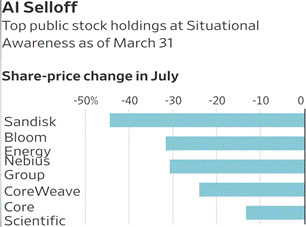
Leopold was loading up on margin, using the assets in his fund as collateral. That’s great when your stocks are moving higher. It’s not so great when your top holdings are falling by 30% or more.
Source: FactSet
Situational Awareness was squeezed by margin calls, and if you don’t have a ton of cash laying around (which the fund didn’t since it was all invested), the young hedge fund manager had to start selling stocks. And sell, and sell, and sell some more.
At its peak, the Situational Awareness fund operated with leveraged ratios of around four times its capital. That meant a 25% decline in stock prices would wipe out all investor equity in the fund. Seriously, was any one with a brain in Leopold’s ear? Anyone? Bueller?
Time to let the adults in the room. Enter the most successful hedge fund manager in the world, Ken Griffin.

The 58-year-old multi-billionaire manages the $400 billion Citadel hedge fund. He knows a thing or two about private and public markets, and he knows a thing or two about risk management. Once insiders discovered where the selling pressure was coming from, Griffin made direct contact with Leopold Aschenbrenner, throwing the young man a lifeline. Griffin offered to stop the bleeding by purchasing beaten-down shares at a discount which would end the margin calls at Situational Awareness while giving Citadel billions in quick profits once the inevitable bounce occurred. Wily veteran, meet the inexperienced upstart.
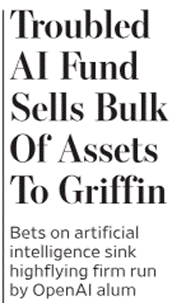
The news went public last Thursday, July 30, making the front page of the Wall Street Journal the next morning.
Source: WSJ, 7-31-26
Leopold Aschenbrenner is still in business, managing “only” $10 billion at Situational Awareness, a drop of 78% in assets from its peak just a couple of weeks prior. Griffin saved the guy and his fund, no question about it. But I’m convinced we haven’t heard the last of this young man. He will likely become a very successful hedge fund manager, if that’s what he chooses to continue doing. Perhaps he’ll go back into the AI world in some capacity. Either way, Aschenbrenner has the money, the drive, and the intellectual firepower to chart his course. And he also now possesses the one thing you can’t learn in a textbook. The scars of experience. And perhaps a little side of humble pie as well. Talk about a potent combination.
So there you go, my friends, the story behind the story of July’s massive sell-off in AI-related names and the subsequent snapback that quickly followed. There’s a lesson here for all of us, from billionaires (any of you looking for a new financial advisory team?) down to the newbie investing his or her first couple hundred bucks. The stock market will behave like a casino if you treat it like one. To turn the odds in your favor, where you’re the casino operator, treat the stock market with the respect and thoughtfulness it demands. Investors who employ a balanced and risk-controlled approach to long-term investing do win in the end. But for those who chase the hottest stocks of the day with no risk parameters in sight, and who double down by using borrowed money, well…even an ample supply of brain power won’t save you when Mr. Market decides it time for one of those pesky little life lessons.