Hello everyone,
- Worries of a Warsh wobble.
“How can he not?!”
That’s what I said to no one in particular (because no one was in my office) after watching Kevin Warsh’s speech last Friday in Jackson Hole. The Fed Chair was offering his economic outlook at the annual confab in the Wyoming resort town.
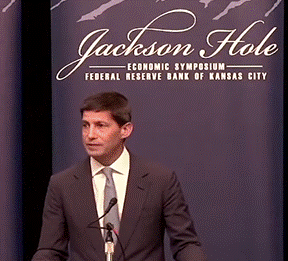
As Warsh was speaking, it was as if I threw my hands into the air and asked aloud, “How can he not raise interest rates now?!” Warsh expressed frustration that inflation remained stubbornly above 3%. Remember that the Fed’s stated target is 2%, shared by both Warsh and his predecessor Jay Powell, who is still a voting member at the FOMC. Warsh stated without equivocation that if policymakers don’t see inflation falling “with sufficient clarity and speed, then the Fed has more work to do.”
You don’t need an advanced degree in Fed-speak to understand what Warsh was getting at. Inflation is NOT falling sufficiently so the Fed is going to have step in and force the issue. In other words, short-term rates must be moved higher, grudgingly or otherwise. Today’s jobs number came in hotter than expected so that will certainly play into the narrative that Warsh and friends should start the next rate hike cycle immediately.
Readers of this commentary know that I’ve questioned the Fed’s desire to raise rates by the end of the year. I still believe Warsh would prefer to sit tight for a while, and personally I don’t blame him. But in my view, the Fed Chair will now lose all kinds of credibility if he wants to keep rates steady at the Fed’s next meeting in 12 days. He’s talking tough. Now he has to back it up.
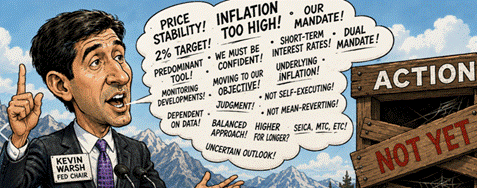
But interestingly, after Warsh’s speech the betting odds jumped to only about 60% that he and the Fed will hike on September 16. No question, there are still a number of Fed watchers who remain skeptical of Warsh’s independence from the President, who has pressured the Fed to cut rates. That’s won’t happen, but sitting on his hands and doing nothing is seen by some to be another form of capitulation. Take a look at this satirical cartoon published after Warsh’s speech in Jackson Hole. Many see Warsh talking tough but ultimately spewing nothing more than hot air for now.
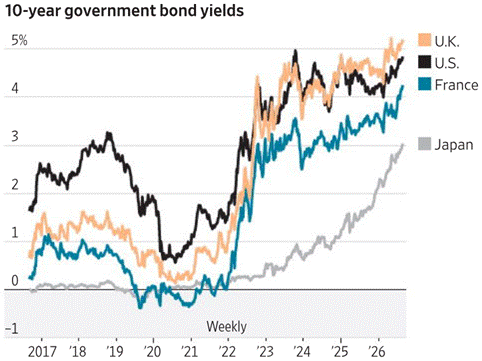
Warsh doesn’t have to appease economists, nor a skeptical press corps. But he does have to answer to the bond market, and there’s no question in my mind that bond traders would like to see the Fed fall in line behind rising bond yields by pushing short-term rates higher. The bond market is focused squarely on inflationary pressures and our growing national debt, and it wants to see a Fed that is taking these developments seriously. So far, bond markets around the world are doing the heavy lifting as you can see in the following slide.
Source: Wall Street Journal, 9-2-26
Policymakers aren’t the ones pushing yields to multi-decade highs. It’s the free and open market of bond traders who expect central banks to join the battle in the fight against stubbornly high inflation. There’s a lot at stake at the next meeting, more than most Fed get-togethers.
Since most people reading this commentary have money invested in stocks, we need to keep this important point in mind. The Fed never raises rates just once. They typically embark on a cycle of multiple hikes until the economy cries “Uncle!” and inflation subsides. Think 2022-23 when the Fed aggressively moved rates higher to curb inflation that had hit a 40-year high. That caused the S&P 500 to fall nearly 25%, the first true bear market since 2008. While I don’t think we’ll see that kind of a drop in stock prices this time around, we certainly can’t rule out an adjustment to the downside if the Fed starts a hiking campaign.
It’s all about credibility, my friends, and you can’t put a price tag on that when it comes to global financial markets. I’m not saying the Fed should raise rates based purely on economic issues. After all, one of the main reasons we’re even having an inflation discussion is due to the on again—off again closing of the Strait of Hormuz. The Fed has no control over that. But that doesn’t matter right now, not when the head of the Federal Reserve was so hawkish in his comments last week. Now it’s about following through.
- Odds and Ends
- It’s one of those statistical anomalies that no one has been able to effectively explain, but September is the only month that has an average negative return over the past 100 years. However, let’s not make too much of it. September has still risen 40% of the time, including the last two years, and the average decline is a mere 1.1%. And when the market is up going into September, as it was this year, the average return for September turns positive for the month historically. No guarantees this time around, of course. But treat this quirky historical phenomenon as interesting, not instructive. If stocks do decline this month it’ll be because of economic developments or geopolitical issues rather than some kind of change in Zodiac symbols.
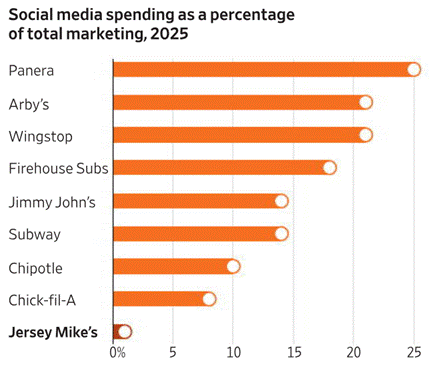
- In the competitive, low-margin world of restaurants, brand name is everything. And the way to highlight that name is through advertising, of course. These days that means social media. I found this next slide interesting, various restaurant chains and their percentage of marketing dollars earmarked to social media ads.
Source: Wall Street Journal, 9-2-26
I have to admit that Panera’s percentage, at least compared to its peers, surprises me a bit. I don’t see them appealing to younger consumers as much as, say, a Wingstop or Chipotle. And that’s really the target market when you’re using social media to advertise, those in the 18-35 demographic. So hats off to the company formerly known as St. Louis Bread Company. Then there’s Chik-fil-A near the bottom. Frankly, I’m surprised they advertise much at all! Some brand names sell themselves purely on reputation, word of mouth, and repeat customers. Mark Chick-fil-A at or near the top of all those attributes.
- I know we’re supposed to forgive our enemies, right? There’s this best-selling book called the Bible that tells us to do just that. But I’m sorry, and I’ll have to repent for this, but I can never forgive Stan Kroenke for moving the Rams out of St. Louis. The decision to pack up the moving vans and head west isn’t my problem. He’s a business guy and owner of the team so he can do what he wants. It’s the way he did it, trashing STL on his way out while leaving behind a trail of lies and mistruths in the process. Nah, I’m not bitter or anything.
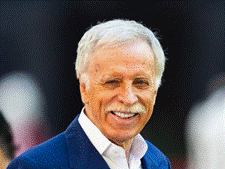
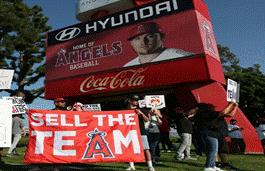
All of this is to say that I have another professional sports team to despise. The Los Angeles Angels. You may have heard the news this week that Kroenke purchased the historically underperforming team for a cool $4 billion, the largest price tag in baseball history. The 79-year-old Kroenke adds the Angels to his growing list of global sports franchises: Los Angeles Rams (football), Denver Nuggets (basketball), Colorado Avalanche (hockey), and Arsenal, the soccer giant in England that is a favorite to win its second consecutive Premiere League title. And that’s the most frustrating part of the story. All of Kroenke’s teams have won titles since he purchased them. ARGH! I’m sure Angels fans are thrilled with Kroenke stepping in to possibly save the team. Good for them.
Since everything he touches apparently turns to gold in the sports world, I have one request of this man. He’s a native of Columbia, MO and a Mizzou grad. If he would donate a few hundred million dollars (why not a few billion?!) to the athletic department at Mizzou, and that leads to national championships, then all will be forgiven. C’mon, Stanley. You can do this. I’ll even throw some roses your way at the victory parade.
Depending on who you talk to, investors are either cautious on the stock market or they’ve jumped in with both feet. For those in the latter camp, that could mean buying additional stocks with borrowed money. Before you even think of doing that, please check out this week’s Simons Says podcast on YouTube. Brandon and I discuss when you should and should not be using margin to make purchases. Please check it out because current margin balances are flashing some warning signs.
Margin Debt Is Surging: Could It Trigger the Next Stock Market Drop?

Stay cool out there, folks. Looks like this heat wave is going to stay with us for a bit longer. That means treadmill running for me. Ugh.
Make it a safe and enjoyable weekend!
Dave