Market monsters lurking.
I’m sure I’ve mentioned this before but I’m a sucker for a good old-fashioned horror flick. I didn’t see “Backrooms” when it opened in theaters earlier this year, but I jumped on it as soon as the movie dropped on Amazon Prime recently.



It’s sort of a cross between “The Blair Witch Project” with the occasional grainy and shaky hand-held camera perspective, and the hit series “Severance” on Apple TV with its claustrophobic setting in windowless offices. There’s a scene at the beginning of “Backrooms” where you just know someone or something is going to suddenly appear from around a corner and suck the life out of the poor sap behind the camera. (Spoiler alert: that’s exactly what happened.)
Many horror movies have the scene. You know the one. The soon-to-be victim slowly shuffles from room to room, intent on locating the strange sound emanating from somewhere in the house. As you crouch down in your seat and squint through your fingertips, you find yourself yelling inside your head, “do NOT go in there!”


But of course, they always do. We know it’s coming, we know how it’ll end, but our heart pulsates all the same.
I really believe a large number of investors today are experiencing a similar type of anticipatory fear. Things have been pretty good for awhile, but they’re starting to hear the music turn from something cheery like “Don’t Worry, Be Happy” to the ominous two-note pattern of the “Jaws” theme.
Pick your bogeyman: the threat of rising inflation, the Fed possibly raising interest rates, escalating hostilities in the Middle East, mid-term elections, overspending on the AI revolution, skyrocketing federal debt….need I go on? That’s enough horror for one commentary.
But are any of those fears new to the scene? Hardly. Mr. Market has successfully navigated around all of them in recent months, even years. I’m not suggesting that a worsening of any of those events will be welcomed with the same laissez-faire attitude going forward. But I am saying that if the market were to falter in the near-term, it might come from a source few are paying attention to. The bogeyman is not in the closet behind you, dear. That’s too obvious. But you better watch out for the hand coming out from under the bed!
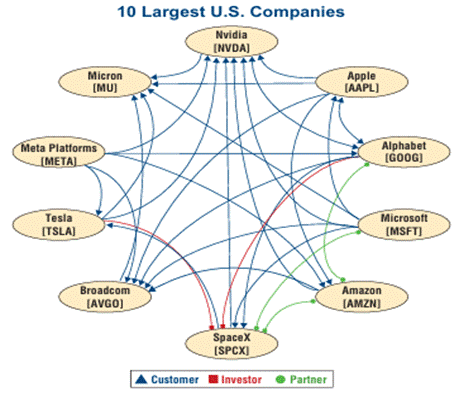
Allow me to present two issues that we’re keeping an eye on here at One Private Wealth, in addition to the others mentioned above. The first is presented in the following chart, something perhaps you’ve seen in a similar illustration.
Source: InvesTech Research, 7-17-26
I don’t recall a time in American history where all the largest companies were so intertwined. A large chunk of their respective profits comes from simply buying and selling with each other. These technology behemoths are so intricately linked that any kind of malfunction in one or two could have a deleterious effect on the whole lot of them. I’m not predicting this will happen with any sense of certainty or confidence. But we’d be mistaken if we completely ignored it, like the passing shadow outside our kitchen window.
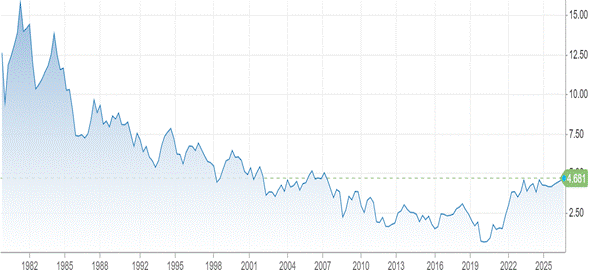
The other concern lies with a development that is not getting near the attention it deserves. This week, the yield on the 10-year U.S. Treasury bond touched 4.7%. Outside of a brief flirtation with 4.9% a few years ago, we’re approaching the highest bond yields in 20 years.
10-year U.S. Treasury bond (Jan. 1, 1980 through July 23, 2026)
Source: CNBC, 7-23-26
If that trendline breaches 5.0% we could start to see cracks develop in the stock market. That’s because investors will weigh a 5% guaranteed return backed by the full faith and credit of the U.S. government, versus the non-guaranteed and volatile returns of the stock market. If you still prefer the stock market over a 10-year timeline, I’m with you. But consider that the shorter 2-year U.S. Treasury is yielding an enticing 4.36%, and now the choice becomes a little more difficult. Do you think the stock market will give you a better annualized return than 4.3% over the next two years? I’m not as confident in answering that as I am with a 10-year outlook. Bottom line, if yields continue to rise the stock market will have some major competition for investment dollars.
I have said a couple of times in recent weeks that I give this bull market the benefit of the doubt until it proves otherwise. But we’re keeping the market on a short leash and won’t hesitate to dial it down a notch if bond yields continue to rise. Let’s keep talking.
- Odds and Ends
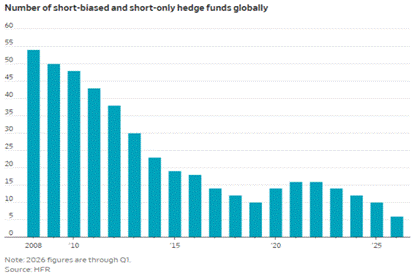
- We’re coming up on 20 years since investors suffered through the Great Financial Crisis. Outside of a few blips here and there (2011 Greek debt crisis, 2020 pandemic, 2021/22 inflation), investors have enjoyed a steady increase in their stock holdings since 2009. That fact has destroyed one obscure and often misunderstood corner of Wall Street. That of the short seller, the trader who bets on stocks going down. It’s been a rough ride for that group of hearty souls, and their numbers are dwindling.
Source: Hedge Fund Research (HFR), through Q1 2026.
The number of hedge funds that specialize in shorting stocks has plummeted from 54 in 2008 to just six today. (Notice a brief resurgence in the aftermath of pandemic-induced volatility in the market.) And it’s not only because of the secular bull market we’ve been riding. We can also point to our legal system and sue-happy culture. Publicly traded companies don’t like to be called out for their accounting shenanigans. I’m not talking about illegal practices, just shady ones that blur the lines of standard accounting practices. Some companies have been successful in their lawsuits against short sellers, causing more firms to shut down their short-selling operations. Too bad. They can serve a worthwhile purpose by publicly shaming renegade companies.
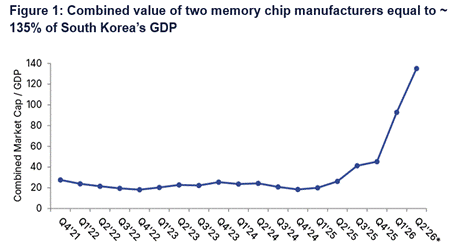
- There’s been a lot of gnashing of teeth over the fact our stock market is largely driven by just a handful of tech-related companies. Well, have you seen the South Korean stock market lately?
Source: The Carlyle Compass, 7-14-26
Just two companies, Samsung Electronics and SK Hynix, account for 46% of the South Korean primary stock market index. Here in the U.S., the two largest companies (Nvidia and Apple) account for 14.5% of the S&P 500. And as you can see in the chart above, Samsung and SK Hynix are worth more than the entire South Korean economy itself! Let me put that in perspective here in the U.S. Nvidia and Apple boast respective market caps of $5.1 trillion and $4.7 trillion. The U.S. economy is currently valued at $31.9 trillion. So for us to be similar to South Korea, Nvidia and Apple would have to be worth a combined $43.1 trillion. Yowza! I occasionally get asked what I think of the South Korean stock market. My response is, “what you’re really asking is what I think of Samsung and SK Hynix.” Caveat emptor.
- I ran across a clickbait headline this week titled “Common MythConceptions.” Kudos to the headline writer. Very cute.
It debunked 70 common myths, what we used to call “old wives’ tales.” I’ll list just a few that surprised me. I admit to thinking these were true.
–“Bulls hate the color red.” Turns out they’re color blind. The bulls are reacting to the fighter’s waving cape and see it as a perceived threat. Color has nothing to do with it.
–“Salieri hated Mozart.” Quite the opposite as it turns out. They were composer friends and maintained a respectful, even friendly, rivalry. Darn you, writers of “Amadeus.” I’ve been living a lie for over 40 years!
–“Shaving thickens hair.” Nope, wrong. Regrown hair isn’t thicker, coarser, or darker. It just appears that way because it’s no longer tapered. Well, alrighty then.
–“Waving your phone around to get a signal.” It doesn’t work. According to the website, the action “does not improve your phone signal. In fact, it makes it worse and makes you look like an idiot.”

Hey, I resemble that remark! I’ve certainly been known to wave around my phone to get a better signal. And you know what? I’m going to continue doing it. I don’t care what the science says. Waving a phone around above my head “feels” like it’s working. And that’s good enough for me, even if I look like an idiot in the process.
I have a new entry for my favorite Simons Says podcast of all time. This one!!!