
Hello everyone,
- Here we go…

Sorry, folks. We’ve got to talk about it. There’s this little thing called the “mid-terms” that occur next Tuesday, and it’s taking up a lot of space in our national discourse. So I guess we should address it from a market perspective, doncha’ think?
Let’s start with the basics. I’ve noted before that returns after mid-term elections are historically positive. Here’s a detailed look at past performance following mid-terms.
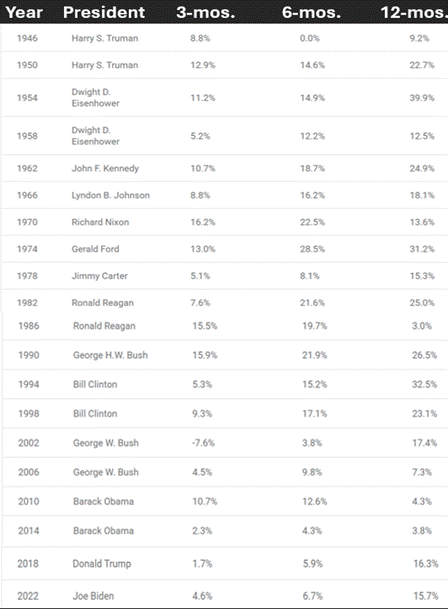
Source: Robert Shiller, Professor Emeritus of Economics, Yale University
The market doesn’t bat a thousand very often, but it does in this particular case. The S&P has given investors a positive return over the 12 months following every mid-term election in the past 80 years. 20-for-20. The simple average return is 18.1%, well ahead of the S&P’s long-term average of 10.4%, with dividends. Even the 3- and 6-month returns are impressive.
You know what comes next, right? “Past performance is no guarantee of future results.” This is one time when many of you are nodding your head in agreement with that legal disclaimer. You’re thinking of any number of things that could go wrong, making those historical numbers obsolete. “But Dave, but Dave! Aren’t you aware that (insert your biggest fear) could likely happen next year?!” I hear you loud and clear. I’m not exactly mortgaging the house to buy more stocks myself just because history is so favorable. A majority of investors must feel the same way based on the latest CNN Fear/Greed Index* concerning the stock market.
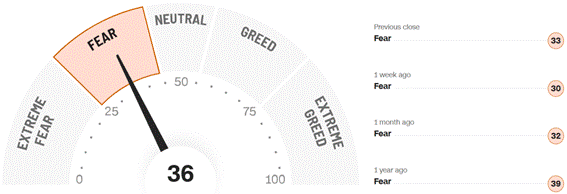
Source: CNN.com, 10-28-26
My contrarian nature loves seeing data like this. The broader market has performed well over the past 12 months. But as you can see on the right of that slide, the needle has been consistently displaying a “Fear” factor among investors. It even dipped into “Extreme Fear” a couple of weeks ago. As I often say, this kind of angst keeps the market honest and investors in check.
I won’t make any predictions about next Tuesday’s results, of course. I don’t know any more than the rest of you. The consensus is the Democrats will likely retake control of the House, and odds have increased in recent weeks that they may also take over the majority in the Senate. Polling data can be wrong, as we’ve learned in recent years, so who really knows for sure. Trump-backed candidates, along with Trump himself, have tended to score a little higher over the past decade than some polls suggest. We’ll see.
But just in case the polls prove accurate, I wanted to see how the stock market (S&P 500) performed when we had a Republican President with Democrats holding a majority in both chambers of Congress. This follows either a general or mid-term election.
Here’s what I found:
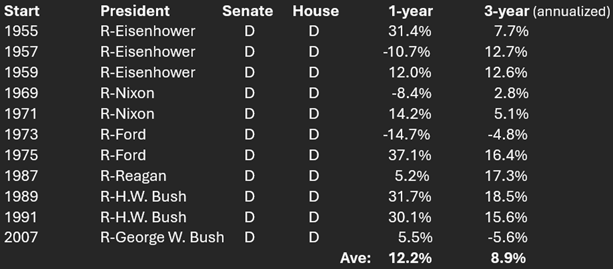
Not quite as positive as the first slide at the beginning of the commentary, but positive for the most part. I wouldn’t pay too much attention to the “average.” The actual returns are all over the board, but at least most of them are on the plus side of the ledger.
And what if the polls are wrong about the Senate? Glad you asked.

Unfortunately, the sample size is quite small and the difference between the two examples is extreme. There’s simply not enough data to draw any reasonable conclusions, but I still wanted to put it out there.
Here’s how I’d handicap various political outcomes and they’d relate to the stock market’s reaction. If a supposed blue wave turns into a tsunami, including victories among a class of far-left candidates who aren’t exactly friendly to free market principles, then odds favor a market sell-off, at least initially. If, on the other hand, Republicans maintain control of the Senate while keeping the Democrat majority slim in the House, I suspect you’d get either a market that sits relatively still, or perhaps even a minor rally. Wall Street loves both parties sharing power, as long as one side doesn’t have anything close to a veto-proof majority in the House and Senate. That’s actually never happened in the history of U.S. politics, and I certainly don’t expect it now.
But if the polls are anywhere close to accurate, I expect Mr. Market will breathe a heavy sigh of relief. That’s not necessarily because the market likes one particular outcome over another. It’s because there were no surprises. Stocks are reflecting, as always, future expectations. That is, a Democrat takeover of the House, and a possible takeover of the Senate. Anything close to the that and the Big Boy and Girl investors will be relatively pleased.
I’ll end with one caveat, and to me it could have a larger impact on the financial markets than next Tuesday’s elections. Reports are that the U.S. and Israel will embark on a major escalation of the Iran war after the mid-terms. President Trump has done nothing to quell the reports, and in fact has publicly acknowledged this will likely happen.

If so, oil prices are expected to jump again, causing inflationary pressures to return. It may be short-lived, who knows. But this is one of the main reasons the Fed decided to stand pat with interest rates on Wednesday. It was more than just holding steady ahead of the elections. Comments from Fed officials point to the unknown of future events, code for both the election and geopolitics.
Much more to discuss next Friday when we’ll all be a little smarter. Maybe.
- Odds and Ends
- You retirees out there may have heard the news that you’ll get a 3.6% raise in your Social Security benefits next year. Benefits, as you know, follow the rate of change in the Consumer Price Index (CPI). That’s why raises were so punk from 2010-21. Inflation was historically low during that 12-year period.
For your viewing pleasure, here are the annual hikes in SS benefits over the past 50 years.
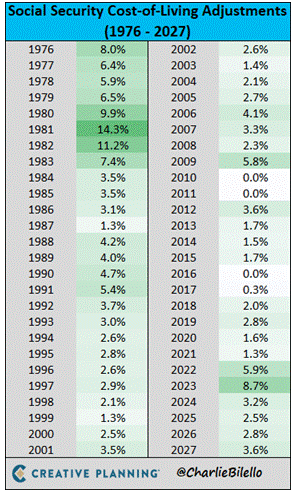
The way benefits are calculated each year is one of the issues on the table for major SS reform. Proponents of such a move prefer a different benchmark than CPI, something that would generate smaller raises. Yeah, I don’t see that happening. I’m highly suspicious that such a move would be in any final legislation approved by Congress and signed into law by a future President. Raising, or even eliminating, the FICA cap is likely to happen in some form. So is raising the FRA (full retirement age) from 67 to…what? Perhaps 69 or 70. But I think the odds of changing the methodology by which SS raises are calculated are very low, in my humble opinion.
- Some of the best suburbs in which to live are in…the St. Louis metro area? YES!
Travel & Leisure magazine just released its list of “Best Suburbs to Live In.” The research was conducted by Liberty Home Products, and they looked at factors including the housing market, crime, median income, education, and commuting. Even the number of sunny days! Here are the Top 10:
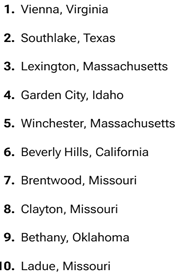
Five of the Top 10 suburbs are located around just two major cities. Lexington and Winchester outside of Boston, and Brentwood, Clayton, and Ladue around St. Louis.
I always push back on critics of St. Louis who cite the city’s high level of crime, racism, poverty, etc. I can’t deny their existence. All true to some extent. But the reports only include the city itself, with a population now of just 278,000 people. The entire metro area is estimated today at 2.27 million residents. Once you include ALL crime statistics in the ENTIRE area, the per-capita numbers drop like a rock. We don’t make any “Worst” lists when that happens. Yes, I’m a proud St. Louis native who’s willing to go to bat for its reputation, warts and all.
- Speaking of my hometown, we have an iconic brand name known as the St. Louis Cardinals. But alas, things have been tough for the Redbirds in recent years. Forget about a World Series title, which hasn’t happened since 2011. The team hasn’t even won its own division (NL Central) since 2019. And counting.
Unfortunately, based on what I saw during the playoffs, the counting will continue for a little while longer. The Milwaukee Brewers, fresh off winning their first World Series title in their 58 years of existence, are the complete team. Pitching, hitting, fielding, baserunning, coaching. Most of their core players are under contract for at least another year, and some for a number of seasons. That includes pitching ace Jacob Misiorowski.


The 24-year-old fireballer is under Milwaukee’s control through 2031 as he can’t become a free agent for another six years. This is essential for a small market team whose payroll ranks 19th in the majors.
This doesn’t preclude the Cardinals making the playoffs via the wildcard route. But then what? They’re going to topple the Brewers and the free-spending Dodgers anytime soon?
We can all dream, of course. But I’m afraid our World Series and division-winning drought may continue for a bit. ☹
They’re baaaaack! I’m talking about day traders. More specifically, I’m talking about workers quitting their jobs to day trade full time, a phenomenon we saw in 1998-99 that eventually ended in lost wealth and lost marriages. It’s the subject of this week’s Simons Says podcast on YouTube. I retell actual stories from the late 90s and issue the requisite warnings about it returning in the future. As I explain, we’re not there yet. But their numbers are growing. Please check it out!
Day Trading Is Back: Why “Boring” Investing Wins in Every Market Cycle

Wish me luck, please. I’m running a half-marathon Sunday in Hilton Head, South Carolina. And I get an extra hour of sleep the night before!
I don’t know how many years I have left to still break 2 hours for the half, which is my reasonable goal for Sunday’s race. Father Time is undefeated so there will come a day when I can no longer break the 2-hour mark. Oh well. As long as I can keep running, I’m more than okay with the inevitable reduction in my race times. I’ll let you know the results next Friday, because I know you’re all so enthralled with my running exploits. 😊
Until then, here’s wishing you all a happy and healthy Halloween weekend!
Oh, one more late addition. R.I.P. to my doppelganger, award-winning actor Patrick Stewart. You wouldn’t believe over the years how many strangers would shout out, “Hey, it’s Captain Picard!” At least a younger version of him.




The British actor passed away yesterday at 86. I’m a goal-oriented guy so it’s my mission to break Mr. Stewart’s “record” of 86. Wish me luck on that goal as well!
Talk to you next Friday,
Dave