Hello everyone,
- Bull market enters 5th year. What next?
Rising interest rates, wars, political strife, AI fears, you name it. The stock market has been teased with a multitude of legitimate reasons to crack but has refused to take the bait. Quite the opposite, in fact. October 12 marked the four-year anniversary of the current bull market, one of the strongest four-year runs in history.
But that’s in the past. Investors rightfully are more interested in what comes next. And for that answer we go to…uh, well…we can’t go to anyone. That’s because there isn’t a single human being who can give us a guaranteed answer to what the market will give us in 2027 and beyond. Even AI isn’t equipped to help us. But history can…up to a point.
Most of you can recite the legal disclaimer by heart. “Past performance does not guarantee future results.” I’ve half-joked about getting that verse tattooed on one of my biceps, or perhaps a calf. The message would be intended for the running and triathlon communities, folks who are hypersensitive to the painful fact that we get slower as we age. But I’m not sure who else would get the joke so I’ve refrained. And my marriage is stronger because of it. 😊

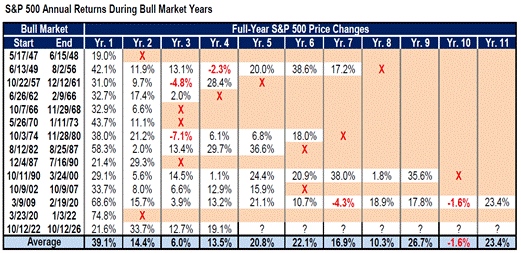
So let’s take a gander at history. Researchers at CFRA went back about 80 years and looked at all bull markets of every shape and size. They found seven that lasted at least four years, not counting the one we’re in currently. Take a look at the data and I’ll meet you on the other side.
Source: CFRA, 10-19-26
In six of the seven previous cases that lasted at least four years, the S&P 500 not only posted at least one more year of gains, but the average return was an impressive 21% in that fifth year. Overall, a bull market with at least four years under its belt lasted an additional 34 months on average and gave us an annualized return above its long-term average of 10.4%. Impressive and encouraging, yes. But just remember the important disclaimer that I once considered tattooing on my body.
(It should be noted that a correction of at least 20% must occur before a bull market is declared dead. That’s why you see some negative returns in red but the bull market is still considered intact until a 20% drawdown occurs.)
One of the concerns I noted earlier centers around the AI phenomenon. In particular, the explosive costs associated with expanding the AI footprint around the world. This should not be readily dismissed. It’s something I’ve written about in the past as I believe we’ll eventually experience a bear market led by the AI trade getting out over its skis. Huge amounts of capital expenditures without the proper amount of return on that capital that investors expect. I can’t tell you the precise moment when those cracks turn into massive fissures. Maybe it’s occurring now? We’ll get some insight into this as AI companies report earnings over the next few weeks. Third quarter earnings are supposed to be robust. But what about 2027 and beyond? Stay tuned over the new few weeks.
Even if AI stocks remain under pressure for a while, that doesn’t have to mean the entire market falls along with them. I’ll pick one specific company as an example. 3M isn’t exactly a hot growth stock. It’s one of those boring old Dow stocks that younger day traders ignore, even mock. “Have fun staying poor, Boomer!”

But 3M is having a bit of a renaissance. The maker of Scotch tape and Post-It notes, along with hundreds of other consumer products, reported earnings earlier this week that blew away estimates. The company also raised guidance significantly for 2027, which caught Wall Street analysts by surprise. The stock has since shot up more than 8% the last four days. Other boring stocks like Coke, McDonald’s, and Johnson & Johnson have also outperformed tech stocks the last couple of weeks. The Dow itself is up 2.4% this month, and that includes this morning’s 750 drop as I’m hitting the send button. That compares to a 4.9% for the Nasdaq 100. Yep, the boring old Dow is outperforming the high-flying index by over 7% the last three weeks.
(I offer no recommendations on the stocks mentioned above. This is for illustrative purposes only.)
This change of leadership, however long it lasts, is an essential ingredient to keep the market treading water while AI stocks are gasping for air. It’s times like these that diversified portfolios shine. With apologies to Ron Burgundy, “diversity” is not some old, old wooden ship.

It’s the tonic that soothes during rough waters, just like what tech stocks are trying to navigate now.
Odds and Ends
a. Speaking of AI, here’s a slide that puts into perspective just how massive this technological revolution is.
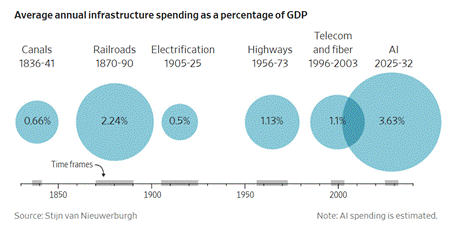
It dwarfs transformative technologies from the past. Only the advent of the railroad from 150 years ago comes close. Some might point out that while these economic upheavals were positive in the long run, they were very disruptive in the short term, particularly when it came to the eventual bust of financial entities that were providing capital to the early adherents of these technologies. There’s some truth to that, for sure. Most notably railroads and the telecom/fiber eras. Investors who ignore history do so at their own risk.
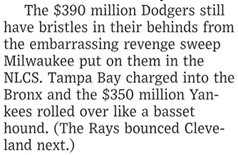
b. There’s talk of an impending baseball strike in 2027. The owners want a salary cap. The players do not. Simple as that. Fans who side with the owners lament how the larger markets (Los Angeles, New York) can afford to sign the best players in baseball. True, say the fans who side with the players. But that doesn’t guarantee championships. The Yankees haven’t won a World Series in 17 years. The Mets are pathetically inept. And look at this year, say the players. Did you notice who the last four remaining teams were? Los Angeles, no surprise. But then you had Milwaukee, Cleveland, and Tampa Bay. The combined payroll of those three teams was $25 million less than the Dodgers by themselves, who were swept by the Brewers in the National League Championship series.
The best sportswriter in the business, Jason Gay of the Wall Street Journal, penned it best:
Personally, I wouldn’t mind some sort of a salary cap, just like the other professional sports employ. But you can’t ignore the results, this year in particular. We’ll see what happens, but negotiations could get really ugly this winter.
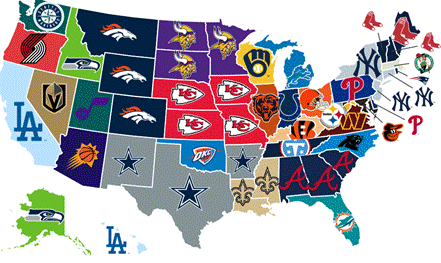
c. We’ll end on another sports note, and a fascinating one at that. Would you have guessed that the Kansas City Chiefs are a more popular sports franchise in Missouri than the St. Louis Cardinals? Such is the power of the NFL. I don’t know if this is the most accurate way to measure fan allegiances, but the result comes from a recent Google research project that looked at internet searches in all 50 states over the past six years. Here are the results:
HIGHEST GOOGLE TRENDS 2021-2026
Source: USA Today, 10-15-26
Some interesting results: 1) The only franchise to show up in four states—the Kansas City Chiefs. 2) NFL teams are represented more than any professional sport (28), and it’s not even close. 3) Baseball is listed 16 times, with most of them along the East Coast. 4) The NBA comes up five times while the NHL show up only once, the Las Vegas Golden Knights. (Nice win last night by the Blues over the Knights!)
I can see why the Braves show up in Alabama and South Carolina since those states don’t have professional teams in the big sports leagues. That’s why I’m a little surprised that the Cardinals didn’t show up in a place like Arkansas. That honor went to the Dallas Cowboys. Seriously?! Man, the NFL is strong.
We’ve always had our hucksters and charlatans out there, and the modern era of social media has only added to their numbers. I highlight just one, a real doozy, on another “Terrible Takes” episode this week on the Simons Says podcast. Yes, people really are this gullible!
Can You Really Turn $500 Into $17 Million? Exposing Viral Investing Claims

A big Fed decision next week, and the midterms the following week. Fasten the seatbelts and get the popcorn ready. And don’t forget to tune in to KMOX (1120 AM) every Tuesday morning at 10 a.m. Central. I give my thoughts on the current state of the financial markets with hosts Chris Ronge and Amy Marxkohrs. You can also listen online at www.kmox.com.
Talk to you all next week!
Dave