Tech stocks suffer in July. Great news!
Let’s jump right into this week’s commentary with a look at three related slides, all connected to Alphabet (“Google”). We’ll use this one company as the poster child for everything good and bad with this phenomenon we call Artificial Intelligence (AI), and I’m speaking purely from an investment perspective.
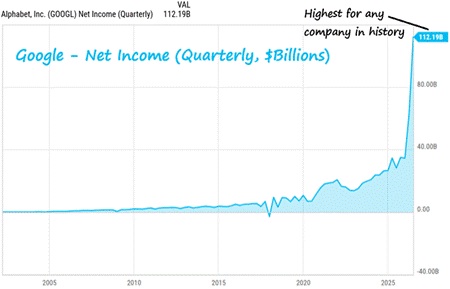
Last week, Alphabet reported more than $112 billion in net income for the second quarter. Again, that’s for one quarter, the most for any U.S. company in history.
Source: Creative Planning, Charlie Bilello, 7-28-26
Quite the 25-year chart, eh? But the record-setting jump in net income had nothing to do with AI. The profits are pouring in from the usual suspects like cloud computing (up 84% from a year ago!), digital advertising (Google Search and YouTube), and subscriptions (Google One, YouTube Premium).
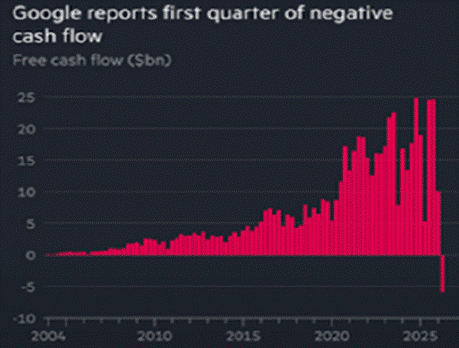
And yet Alphabet shareholders were not impressed with the earnings report. Why is that, you ask? For the answer we turn to the second slide.
Source: Thoughts From the Frontline, 7-25-26
You’re looking at Google’s quarterly cash flow numbers for the last 22 years. All positive, no surprise. Until the last quarter, that is. The quarter when the company reported over a $100 billion in income! And that’s where we bring in the subject of AI. Google is not only spend a boatload of money on expanding their AI footprint, they’ve also taken to the debt market to borrow additional dollars for their capital expenditures related to AI.
Shareholders have grown restless, pushing the stock down close to 20% since late May.
ALPHABET (3-month chart)
Source: MarketWatch, 7-29-26
Despite record topline revenue, investors have been selling the stock based on the company’s bottom line, a bottom line that is withering away. And there’s no relief in sight. Alphabet plans to spend in the vicinity of $200 bill this year on AI alone, dwarfing the profits rolling in.
Now comes the disclaimer. I offer no opinion on Alphabet’s stock. It’s obviously one of the major players in the AI universe and most analysts believe it will continue to play a major role. I’m merely using the company as a prime example of the dilemma facing investors. Counterbalancing record profits with record spending. Investors and/or their advisors will have to determine the various risks and rewards and act accordingly.
It’s not just Alphabet, of course. Meta (Facebook) just announced record profits of its own, while at the same time reporting a 91% drop in free cash flow. Its stock has plummeted about 20% over the last two weeks. Amazon released earnings after the bell yesterday (Thursday) and it too reported negative cash flow in the second quarter because of AI-related spending.
Amazon CEO Andy Jassy told analysts, “you ain’t seen nothin’ yet.” Capex spending will continue to increase through at least 2028! (As an aside, there may not be a better CEO in the land than Mr. Jassy. Jeff Bezos picked himself a good one.)
But let’s not equate July’s tech selloff with what’s happening across the rest of the market. Bank stocks, for example. An index of financial-related companies is hitting all-time highs and is up over 15% in just the last two months. Don’t overlook this. If bank stocks were rolling over I’d have larger concerns about the broader economy and stock market. But for now, the majority of the damage is being relegated to tech companies in general and to AI-related stocks in particular. Perhaps we’ve seen the worst of it as the techies have significantly rallied the last couple of days. We’ll see if it has any staying power.
I’ll leave you with this little nugget. While the Nasdaq 100 recently entered official correction territory (down more than 10%), the S&P’s drop has been less than 4%. Over the past 75 years, a bear market has never occurred if it took the S&P more than 40 days to fall at least 5%. We’ve long since passed that timeline. This doesn’t guarantee us anything, of course. But it does strengthen my conviction that a selloff in the highfliers is not only welcome news, but that it will not spread to the rest of the stock market anytime soon. My humble opinion.
Odds and Ends
I was wrong. Or was I right? I’m so confused. That’s how I felt after listening to Kevin Warsh on Wednesday.

The Fed Chairman was explaining why he and his cohorts decided to leave short-term interest rates right where they are, while acknowledging that inflation remains problematic.
I’m on record stating that I don’t believe the Fed will raise rates this year, adding the caveat that my confidence level isn’t very high when making that prediction. I get the feeling that Fed members want to eventually raise rates. Indeed, three of the 12 voting members wanted to do it this week. But Warsh appears content with letting the bond market do the Fed’s dirty work, which is exactly what’s been happening as bond yields have been rising on their own all year, some maturities hitting 20-year highs. So for now, I’ll stubbornly stick with my assertion that the Fed won’t raise rates, but please don’t go to the prediction markets and bet any money on it. It appears the odds are slowly moving in the other direction, toward at least one or two hikes before the end of the year. The next Fed meeting is set for September 15-16.
- Add this item to your “too crazy to believe” list. You’ll recall that the U.S. had reported budget surpluses (yes, there was such a thing!) for four consecutive years in the late 1990s. That prompted the Congressional Budget Office (CBO) to report that the trend of surpluses was about to become the norm, not the exception. The agency actually issued a release that surpluses would grow so large that the U.S. government, if it were so inclined, could redeem all government bonds within five years. I am not making this up! In fact, the CBO was so sure of itself, that it convinced the Treasury Department to stop issuing 30-year bonds in 2001. But just five years later, on February 9, 2006, the Treasury reintroduced 30-year bonds due to the widening budget deficit. Ooops!
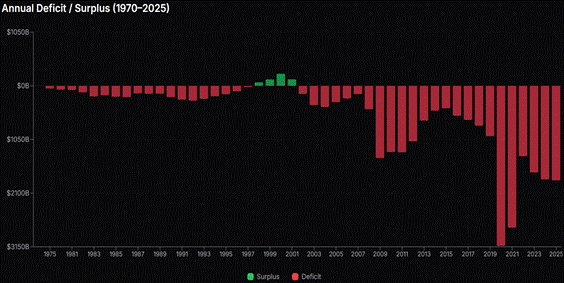
Source: U.S. Debt Clock.org
Fast forward to current times and you can see that annual budget deficits have exploded. We can’t blame the Great Recession and Covid anymore. The total federal debt is approaching $40 trillion, and our elected leaders have little interest in addressing the issue. It will matter when it matters, but it will matter someday.
- I occasionally stumble on a piece of random data that catches my attention and think, “Oh man, this is good. I’ve got to share this with my readers!” I was struck by such an epiphany this week when perusing a report on labor statistics. (Sounds exciting, eh?) The following slide reveals how Americans spend their day. No surprise that age makes all the difference, but you’ll also pick up on the occasional gap between genders.
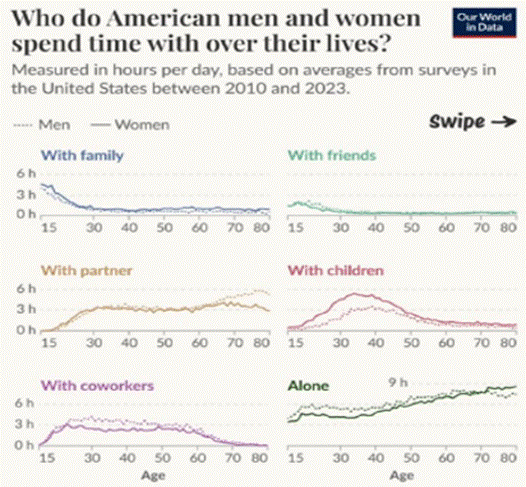
Source: U.S. Bureau of Labor Statistics
The one that really caught my eye is the “with partner” trendline. It jumps from zero hours when we’re basically kids, up to about three hours a day when we now have a significant other. But look at what happens later in life. We get a separation between genders. (The dotted line represents men, the solid line is for women.) Two things are represented by that gender gap. One, an elderly man is more likely to still be married than an older woman since females have a longer life expectancy. Second, and most intriguing to me, is that once the husband dies it’s more likely that the widow will remain single through her remaining years. A widower is more likely to find a partner for the rest of his life.
Face it guys. They can live without us better than we can live without them. That is one harsh truth bomb!
It must have been “pastel day” at One Private Wealth when Brandon and I recorded this week’s podcast. So bright and cheery!
But our mood turned a little more dour once we got talking. We tackle a very serious topic, one that has affected people very close to us, and likely close to you as well.
If you have older relatives and friends, or people you’d consider vulnerable to financial scams, I urge you hit the link above.
August is here and college football is just weeks away! Now for the sad truth. I only say this when the Cardinals have dropped out of playoff contention. Sadly, an all-too familiar occurrence in recent years. ☹
Talk to you again next week!
Dave