Hello everyone,
1. Fed actions and what it means to you.
Most Fed meetings are rather inconsequential and receive little attention by most Americans. But these are consequential times and this week’s Fed meeting rightly received an overabundance of attention by most Americans.
Here are the most important takeaways and why you should care:
*Credibility. This is more subjective, more nuanced, than good old fashioned economic data. But I would argue that Kevin Warsh’s credibility, reputation, and independence are no less important than facts and figures, perhaps even more so. Some feared that Warsh would serve as President Trump’s puppet in lowering interest rates, something I’ve pushed back against.
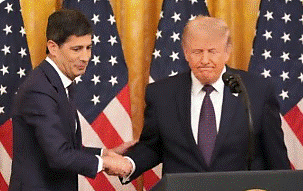
I wrote at the time of Warsh’s nomination, and have continued to opine, that I believed Warsh would display a sense of independence from the get-go. That had been his history since the first time he served as a voting member of the Fed nearly 20 years ago. In addition, he has a well-earned reputation as a hawk, someone who sees inflation and easy-money policies as a threat to economic growth. I firmly believed he wasn’t going to suddenly change his stripes and become a lackey for a President who prefers interest rates near zero.
But some folks just can’t let it go. At Wednesday’s news conference following the Fed’s announcement to raise short term rates, some media members were still asking questions about Warsh’s independence while invoking Trump’s name. Warsh rightfully declined to address the issue and moved the conversation back to the important task of bringing inflation down closer to 2%. This issue needs to be put to bed. More than that, it needs to be buried for good.
*Bond market.
Warsh doesn’t need credibility from the media, but he needs it in abundance from the bond market. If Warsh had convinced his fellow voting members to stand pat on rates, bond traders would’ve thrown a fit. Long-term yields would’ve spiked, stocks would’ve dropped precipitously, and the Fed’s independence would’ve been rightly called into question. It’s not hyperbole to say we might’ve had a mini crisis on our hands, particularly in the Treasury market. Bond traders have been trying to get everyone’s attention that we’ve got an inflation issue that needs to be addressed, and it could get worse before it gets better.
Without the Fed’s assistance, bond vigilantes have been pushing yields higher since the war started in late February.
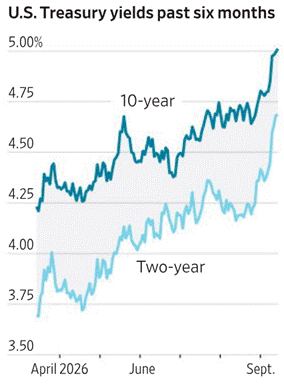
Source: Wall Street Journal, 9-16-26
Interestingly, but not surprising, bond yields have stabilized since the Fed’s announcement. The bond market has been doing all the heavy lifting this year and now believes it has a reliable partner (the Fed) in which to tackle inflation.
*More to come?
Very rarely is the Fed ever “one and done.” The Fed meets two more times this year, October 27-28 and December 8-9. The bond market is pricing in at least one more hike this year, and some analysts are calling for two. Either way, we can’t ignore the presence of politics in this decision. The Fed’s next meeting is just six days before the midterms on November 3. Warsh and Company will be criticized either way. The Republicans will howl if the Fed hikes again just before Americans go to the polls. Democrats will cry foul if the Fed stands pat, arguing that it’s purely a political decision. Get the popcorn ready.
*Worthy debate.
Normally the Fed raises rates when economic growth is overheating and pushing wages higher. Neither of those is happening today. Economic growth is good, but “hot” it is not. And wages are lagging inflation. Today’s inflation is mainly the result of supply-side shock due to the Iranian war. Regarding that, the folks who were arguing against a rate hike make a valid point. Moving rates to the upside doesn’t end the war, and certainly does nothing to solve higher gas and food prices. Again, this is not a demand-side bout of inflation. The anti-hike crowd argues the Fed is now risking a very deep recession since many Americans are already hurting in the pocketbook. Higher rates will only pull more Americans into financial distress. This is a very valid debate and could have major implications months from now.
*Consumers/Investors
A quarter point hike may not sound like much but many Americans, depending on their current financial situation, will be immediately impacted. Credit card companies quickly raise borrowing costs upon Fed moves. Same with home equity lines of credit, or HELOC’s. Fed hikes normally do not affect traditional mortgage rates as they are based on the 10-year bond yield. As noted earlier, that yield has stabilized since Wednesday. On the plus side, money market funds and savings accounts should see a slight uptick in yields, although that normally takes a few days or weeks to get priced in. Funny how that works.
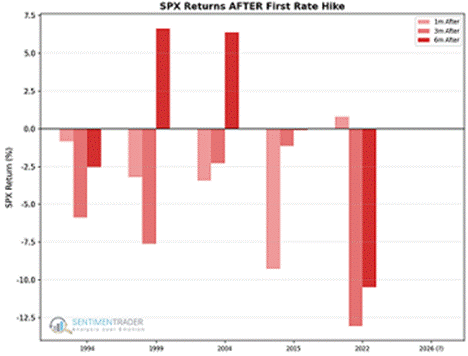
As for investors, it’s a little trickier. As you can see in this slide, the stock market doesn’t exactly respond favorably to the start of a Fed hike cycle. I’ll explain what you’re looking at on the other side.
Source: Sentiment Trader, 9-17-26
The illustration shows how the S&P 500 responded to the last five cycles of Fed hikes dating back to 1994. In each cluster, the first bar represents the market’s return one month after the first hike, the second bar shows the return three months later, and the third bar (the dark ones) is six months after the first hike. Although past performance doesn’t guarantee future results, notice that the S&P was down 1-3 months later in every instance except for one month after the 2022 cycle started. But yikes, look what happened 3-6 months later!
I make no predictions, other than to say it wouldn’t surprise me if the broader stock market follows history. Nothing major to the downside in my opinion, but I certainly don’t see a near-term catalyst to boost prices significantly higher for now.
No major moves on our end just yet. We’ve been dissecting our models, making sure we’re not overly exposed to the most interest-rate sensitive investments. Our largest fixed income positions remain in short-term T-bills and corporates, which are less susceptible to wild principal fluctuations. On the stock side, we continue to overweight healthcare names, and it’s the big pharma stocks that have really driven performance this year. Financials certainly are affected by higher rates so we’ll be watching those holdings carefully. But our largest holdings in that space have outperformed the broader market in 2026 and we’re not looking to start scaling back just yet. We’re there because of increased investment banking and IPO activity and we don’t see that subsiding even with higher rates.
Hope all of that helps! Please reply with any questions you may have.
2. Odds and Ends
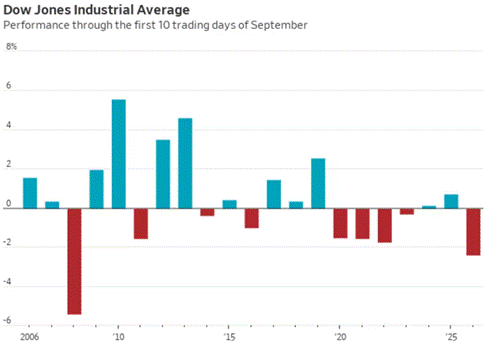
a. September has lived up to its infamous reputation so far. Through the first 10 trading days of the month, covering 15 calendar days, the Dow declined a little more than 2% through the first half of September. A pretty minor pullback, of course, but very routine for the 9th month of the year. Historically, September has recorded the worst annualized return of any other month dating back to 1928.
Source: Marketwatch.com, 9-16-26
With eight trading days still left to go, this September’s performance is shaping up to be the worst since 2008. Remember that year? Yeah, how can we forget. The Dow dropped nearly 6% that September before plummeting another 14% in October. The S&P 500 and Nasdaq posted even worse declines, officially ushering in what would be known as the GFC, or Great Financial Crisis.
No, I’m not hinting that we’re in danger of following 2008’s lead. Nothing close to that. But September has a well-earned reputation of kicking off a corrective cycle through the early days of fall, and the Fed starting to raise rates certainly doesn’t help.
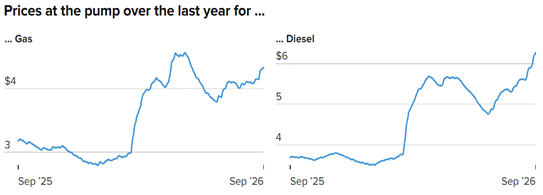
- Back to the inflation story for a second. I want to reiterate the Fed’s dilemma here. Hiking rates will probably not solve the following problem:
Source: CNBC.com, 9-16-26
Again, this is not a demand issue but a supply one. The only way prices come down is a de-escalation of the war, if not an outright end to all hostilities. Even then it will take a while to get supply chains up and running to full capacity. The second way to bring prices down is not nearly as favorable. The Fed keeps hiking rates to the point we enter a deep recession. That’s when it becomes a demand issue even with lower-than-normal supplies of oil. I think we’d all vote for Door #1.
- As always, let’s end on a lighter note, and a rather entertaining one at that. My long-serving assistant, Kathy Delmain (27 years by my side!), passed along a link she knew I’d find interesting. It’s rich with cultural history, right up my alley. And it’s done in a visually appealing manner. By clicking on the following YouTube link you’ll see how Americans have gone about their daily routine from 1920 to the present day. I won’t give anything away but the changes are fascinating.
How We Spend Our Time? Data from 1920 to 2026
So that got me exploring other pieces this company has produced and I came across another one that piqued my interest. It answers the age-old question posed to kids: “What do you want to be when you grow up?” I guess I’m showing my age but the answers went from being cute decades ago to alarming today. You’ll likely agree. Enjoy!
Kids’ Dream Jobs? Data from 1920 to 2026 – YouTube
Speaking of YouTube links, please click on the following to view this week’s Simons Says podcast. I answer another age-old question. How much money should one have in investments/savings to retire? I work through the calculations and demonstrate that it’s not as complicated as many make it out to be. Please check it out!
How Much Money Do You Need to Retire? Calculate Your Personal Retirement Number
As a reminder, I’m taking a short breather so there will be no commentary next Friday. However, a new Simons Says podcast will still drop next Wednesday as usual. Anyone who loves baseball will enjoy the analogy I use to describe how old rules don’t always apply to today. That’s next Wednesday.
Make it a great couple of weeks and I’ll talk to you again on October 2!
Dave