Hello everyone,
- The end of the AI trade…someday.
Just minutes before the highly anticipated 5000-meter race at the 1972 Olympics in Munich, ABC’s Jim McKay asked a running analyst if Steve Prefontaine, the brash young American from Oregon, could actually win gold at the distance.
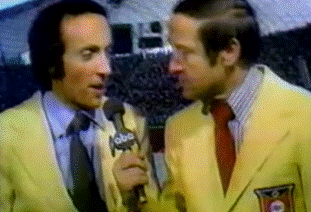

Track analyst with ABC’s Jim McKay USA’s Steve Prefontaine, 1972 Olympics
“Steve Prefontaine will be the Olympic 5,000-meter champion. I think he will break the world record at 5,000 meters. But I think he will have to do it in Montreal (in four years), because today Steve Prefontaine is 21 years old and he’s running up against the very big boys.”
If anyone knows the commentator’s name on the left, please email me. It’s killing me I don’t recognize him! I’m assuming he was a former track star himself, most likely from the 1960s. (Marty Liquori, perhaps?) Turns out that his skepticism of Prefontaine winning a medal was spot on. “Pre,” as he was affectionally known, led at various times during the race, but was eventually outgunned at the tape by three more seasoned veterans and stumbled to a 4th place finish. We’ll never know if he would’ve won gold in Montreal in 1976, as the analyst predicted, or set the world record in the 5k. Many of you will remember the story. Steve Prefontaine died in a one-car crash in the hills surrounding the campus of the University of Oregon in 1975.
But we’re not focusing on that tragic event, only on the comments make in the broadcast right before the starting gun was fired. The analyst teased McKay and millions of viewers by saying that Prefontaine was going to win gold. Just not today. Not now. He’d have to wait another four years.
It’s strange but that iconic quote (iconic to running nerds like me) came to mind as I was explaining my thoughts on KMOX of a possible AI bubble eventually bursting. My brain always finds its way to sports or music analogies. In this case, I could hear that running analyst in my head, but this time opining on a possible bear market led by meltdown in AI-related stocks. “The market is going to burst. Investors who are top-heavy with tech stocks are going to feel the brunt of the pain. But not today.. Investors will have to wait (months/years) from now.”
Market professionals, including yours truly, have differing opinions on just when this party will end, but end it will. Heck, even the usually mega-bullish Jim Cramer has remarked that this AI revolution will eventually end in a trail of tears. Not for the industry itself, which will continue to thrive, but for many of the companies now seeing their stocks hit one record high after another.
But not now. And probably not for a while. Like Prefontaine in 1972, the AI revolution is still relatively young. It’ll have to mature before we see earnings start to slow down. But for the time being, earnings growth is so momentous, so explosive, that I don’t see it coming to a crashing halt for….geez, I don’t know when. Trillions of dollars in spending are already accounted for well into 2028. I know there’s a lot of controversy over the building of AI data centers, but they will be built. Somewhere, somehow, someway.
Take a gander at the exponential growth in S&P earnings in just the last three years, a cumulative rise of 65% since 2023. And virtually all of it related to artificial intelligence in some form and fashion.
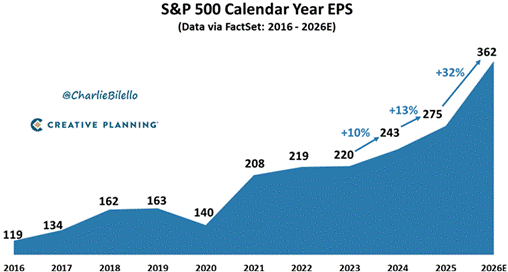
Analysts have continued to underestimate this kind of unprecedented earnings growth and I suspect they will remain behind the curve for some time.
You may be tired of me saying this, but I feel the need to constantly remind investors that giving this bull market the benefit of the doubt does not preclude corrections along the way. Some investors might wonder if we’re entering one now with the Treasury’s attempt to lower yields running up against the strength and power of bond traders. Just remember, my friends. Always pick bond vigilantes in a fight. They’re pretty much undefeated. Fortunately, they’re not provoked to fight very often.
I’ll leave you with another quote, this one from CNBC’s Carl Quintanilla. His colleagues were discussing this very issue of when a possible AI-fueled bear market might begin. Quintanilla jumped in by offering the most poignant statement on the matter. “It’s not about being right. It’s about when you’re right.” Exactly. A number of market professionals were predicting calamity during the heady days of the Internet. Unfortunately, they were offering their dire predictions years before everything imploded. Some institutions went out of business for betting against the continued rise in internet stocks. They got the call right. Unfortunately, they got the “when” part dreadfully wrong.
The AI revolution will eventually follow the same pattern as every other great technological revolution. Boom and bust, and then a more sustained boom that many investors will refuse to believe for quite a while. Scars run deep. But until then, it’s foolish to make significant changes to one’s portfolio in an attempt to outthink Mr. Market, to get ahead of him before he pulls the rug out. Like a good dance partner, we’ll follow his lead instead of merely guessing where he might be taking us. Staying fully invested, but with proper defensive hedges in place, will continue to be our plan of action for the time being.
- Odds and Ends
- You may have heard the news that our national debt just breached $40 trillion for the first time. And this comes when the economy is growing, a time when we should be paying down our debt, not adding trillions to it every year. The federal debt load has more than doubled in just the past 10 years, from $19 trillion in 2016 to the $40T mark today.
Here’s a slide that puts it in perspective. It’s a 10-year lookback that shows the gap between what our government brings in from tax revenue every year and how much it spends. You can see that this year we’re spending nearly $2 trillion more than we’re collecting.
Source: Creative Planning, Charlie Bilello
Any household that engaged in this kind of behavior would’ve declared bankruptcy years ago. Nice to own the world’s largest money printing press. As I’ve always said, it’ll matter when it matters. And it will matter at some point. It’ll likely start with the bond market breaking, but like the Prefontaine analogy above, no one knows for sure when that will finally happen. Perhaps it’ll take the next recession to start the unwinding process, who knows. I’ll continue to chime in on this very important matter.
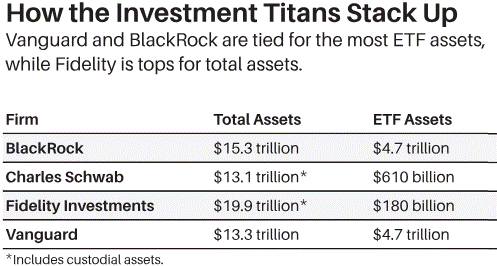
- I remember it like it was yesterday because the news was so startling at the time. In December 1999, Fidelity became the first investment institution to surpass $1 trillion in assets. My, how quaint. Look at how the numbers stack up today between the four largest investment management behemoths.
Source: Barron’s, 8-17-26
Fidelity is about to touch $20 trillion, and that’s without participating much in the ETF (exchange traded funds) business. Vanguard and Blackrock are tops in that industry. There are a few reasons for this explosive growth and I’ll highlight just one because it’s personal. Thousands of financial advisors are leaving the big wirehouses and banks and going independent, just as we did almost exactly two years ago to the day, August 22, 2024. The Registered Investment Advisor (RIA) we joined, &Partners, custodies our client assets at Fidelity. For what it’s worth, &Partners is now the fastest growing RIA that works with Fidelity, expecting to top $65 billion in total assets by the end of the year. And to think that &Partners is just one independent player among thousands. Expect this trend to continue for many years.
- My wife and I have been dog owners since the first year we were married. In fact, I’ve had a dog in my life since my parents brought home our first canine (Shetland Sheepdog) in 1975. So when I saw a headline about the most “Pet Friendly Cities” in the U.S., that was obviously clickbait material for me.
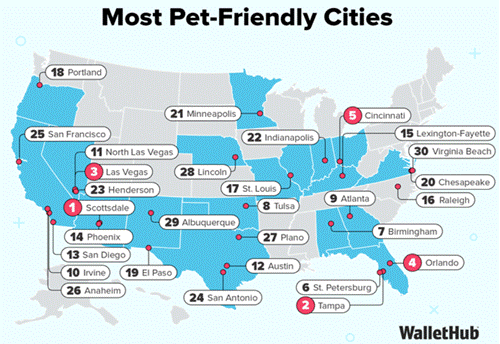
Researchers at WalletHub looked at a number of key metrics from the availability of vets and pet-friendly stores to the prevalence of parks and how walkable each city is. My hometown is 17th, not bad. Scottsdale takes the top spot due to “an extremely high number of pet businesses and dog-friendly shops per capita.” In last place? New York City. No real surprise. The “Concrete Jungle” indeed.
I know there are plenty of Dave Ramsey fans out there, and I give him his just due. Especially when it comes to reducing personal debt. But the man can give some terrible, even dangerous, investment advice for retirees. In this week’s Simons Says podcast, I poke holes in one of his more controversial recommendations. Another edition of “Terrible Takes!”
Dave Ramsey’s 10% Retirement Withdrawal Advice Could Dramatically Impact Your Retirement

Enjoy the weekend, everyone. I’ll be competing in a race on Sunday morning and then settling in to watch the final round of the BMW Championship. But alas, at home instead of in person. No matter. It still sounds like the perfect weekend to me!
Dave