Hello everyone,
- The Enforcer is getting restless.
Hockey great Brett Hull once remarked that he would not have scored as many goals in his Hall of Fame career (741, 5th all-time) ) if he didn’t have enforcers on the ice protecting him. He specifically noted his wingman, Kelly Chase.


The two were Blues teammates from 1989-94, and again during the 1997-98 season. (Chase played for two other teams in the interim.) I had the pleasure of getting to know both men on a personal level when I covered the team for KMOV-TV in the early 1990s. One conversation I had with “Chaser” stands out to this day.
We were sharing a couples of brewskis at a bar somewhere in western Canada, the exact location I cannot recall. Kelly showed me the gnarled fingers on his right hand, his weapon of choice when pummeling his opponents. Unfortunately, swinging at a moving target meant that his knuckles frequently smashed into his antagonist’s helmet, thus the broken bones and scars on that hand. But here’s the part I recall most vividly about that conversation. Chase admitted he didn’t actually care for fisticuffs. He knew what his job was, the reason why he was able to stay in the NHL for as long as he did. But he didn’t particularly relish going up against NHL heavyweights back in the day of Bob Probert, Stu Grimson, and Marty McSorley. Would you?!

Kelly Chase can certainly appreciate the comparison I’m about to make when employing his name. I want to introduce you to another guy who doesn’t actually like fighting, but readily accepts the challenge when called upon. This guy is also a needed and well-respected force in his line of work. He serves a much-needed role in making sure everything works smoothly and no one gets out of line. I don’t know what Chaser’s won-loss record was as a pugilist on the ice, but I can tell you that this other guy is undefeated. Thankfully for his potential opponents, he doesn’t choose to fight very often.
No, I’m not talking about Rocky Marciano or Floyd Mayweather Jr., two boxing greats who retired undefeated. In fact, and I’m sorry about the misdirection, I’m not referring to a “guy” at all. I’m talking about a collection of men and women, tens of thousands of them around the world, who fashion themselves as professional bond traders. They work at mutual fund companies, pension plans, central banks, and various financial institutions across the globe. Collectively, these bond pros play in an arena that’s more than 50% larger than the stock market. We’re talking roughly $160 trillion in bonds versus a little more than $100 trillion in equities around the world. And who is the most important player in that bond arena? The one you want to appease at all costs lest he grab you by the cuff of your jersey and start wailing away? It’s not a “who” at all. It’s a “what.”
The “long” bond. The 30-year U.S. Treasury.
There is no more important financial instrument on God’s green earth. The price of the 30-year bond (and by extension, its yield) signals to the world how strong, safe, secure, and dependable the U.S. government is at any point in time. Thankfully, those attributes have been called into question only a handful of times since the end of WWII. And each time it was the the so-called bond vigilantes who were called into action to bring accountability back into America’s monetary and fiscal policies that were in danger of running off-track.
Well, my friends, we’re unfortunately approaching one of those times when the vigilantes are stirring. They haven’t put on the boxing gloves just yet. But they’re clearing their throat to get our attention, a friendly reminder that they’ve been awakened to the parabolic growth in our federal debt. They’re not there yet but at some point, if we don’t get our house in order, they will take their pound of flesh and then some. They’ll not only start selling long-dated U.S. Treasuries, but they will restrict their purchases of new issuances. That’s what happens when bond traders start to question whether the U.S. government can be trusted to pay its bills years from now.
Sure, we could inflate our way out of this mess by simply printing more money. But that typically doesn’t end well. Meanwhile, Treasury Secretary Scott Bessent says the Treasury will start buying billions of dollars of long-dated bonds in an effort to keep the 30-year yield from rising much higher. Sorry, but that will have little impact on vigilante behavior. As I said last week, when bond traders collectively battle against any governmental agency, always put your money on the bond market.
(You don’t have to take my word for it. Stanley Druckenmiller, one of the most successful hedge fund managers in history, wrote an explosive op-ed in the Wall Street Journal on this very topic Monday. I urge you read it even if you don’t subscribe to the Journal. I’m sure you can find it online somewhere.)
It doesn’t take an Econ major to know that there are only two ways to reduce the annual deficit and slow down the growth of our overall debt load. Raise taxes and/or cut spending. It’s really that simple. But good luck with that. There is absolutely no political will to tackle either one.
You can raise all the taxes you want on billionaires but that barely puts a dent in our annual deficit, now approaching $2 trillion this year. (The overall cumulative debt just topped $40 trillion.) We can cut spending, but where? Take a look at this slide and I’ll meet you on the other side.
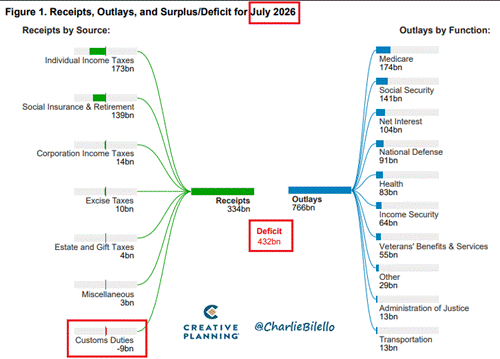
This is an eye-opening illustration of the government’s July revenues (the left side) versus its expenditures (right side). The difference between the two last month was an astonishing $432 billion. One month! Now you tell me, where do you want to cut on the right side of that slide? Social Security and Medicare? How about defense or Veteran’s benefits? Meanwhile, the net interest on our debt continues to take a larger chunk of the pie as this next illustration reveals.
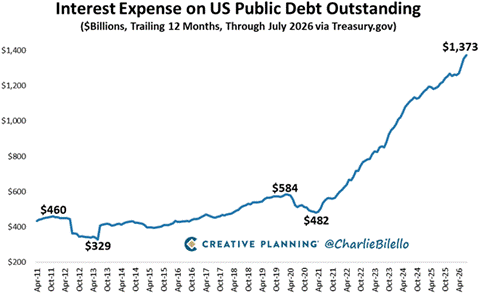
There is so much more to address on this subject but I’ve got to end it here. Just know that you can bet your bottom dollar that you haven’t heard the last of this from me. Nothing to do today. No rash decisions need to be made in our portfolios. But as I mentioned in a recent podcast, I suspect the 2030s could get a little rough economically unless politicians start taking action yesterday. I’m not holding my breath.
- Odds and Ends
- I’m sending this commentary before Fed Chairman Kevin Warsh delivers his keynote speech at the annual Jackson Hole confab. My own guess is that his words will not dramatically move the financial markets. Of course, you’ll all be smarter than me because you’ll have the benefit of hindsight by the time you read this. But Warsh has been very public about NOT being very public. It’s doubtful he will offer any significant guidance on what he expects the Fed to do with interest rates in mid-September. I’m sure he’ll give lip service to the Fed’s ongoing battle with inflation, but I seriously doubt that offer any revelatory information that’s not already known.
Just one additional comment here. I have no idea if the Fed will raise rates next month, but I actually think the market would respond positively if they did. It would show the Fed means business in its fight with inflation and further dampen speculation that Warsh is acting solely at the behest of President Trump. In fact, if Warsh actually does tackle the inflation issue with more gusto today then you might see a bit of an equity rally while the yield on the long bond comes down. But as I said, we’ll all be smarter later today.
- I remain convinced that the AI revolution will eventually end in tears for investors who stay too long at the party. But I’ve been careful to note that we’re not close to that occurring just yet, and this week’s earnings report from Nvidia proves the point.
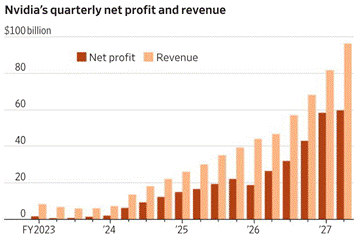
Source: Wall Street Journal, 8-27-26
The behemoth in AI chip manufacturing, Nvidia blew away all estimates in both top line revenue and net profits for the previous quarter. But those numbers were nothing compared to what the company predicted going forward. Nvidia expects its revenue to grow at least 70% through 2028. And that number would be higher if it could satisfy all the orders coming in. They can’t build out their manufacturing capabilities fast enough to keep up with demand. I offer no opinion on the stock, nor on other AI-related companies. But the earnings numbers we’re getting from this space are not only slowing down, they appear to be accelerating. I’m not one given to hyperbole, but it’s safe to say we’ve never seen anything like this technological revolution in modern economic history.
- I had quite a few guesses last week as to who that running analyst on the left is. Congrats to reader Brian G., the only one to nail it.
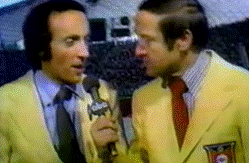
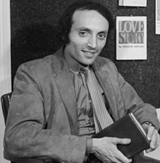

Believe it or not, it’s Erich Segal, the author of the best-selling novel, Love Story. Segal also wrote the script for the movie, starring Ryan O’Neal and Ali McGraw. I had an ah-ha! moment as soon as I saw Segal’s name. I remember coming across this controversial story when reading about the marathon of those Munich Olympics, the one that Frank Shorter won which kicked off America’s first running boom. Segal was picked as the color analyst for that race, but it wasn’t a random selection despite what people thought at the time. Segal was an accomplished runner himself, finishing marathons in under 3 hours. His actual job was that of a professor of Greek and Latin literature and, get this, had Frank Shorter as a student at Yale. Consider, too, that Segal had a pretty big name at the time, both his book and movie coming out just two years earlier. It was actually a pretty smart decision by ABC execs and Segal acquitted himself very well.
So there you have it (as Mike Bush would say)…the rest of the story (as Paul Harvey would say.)
When it comes to whether politicians should be allowed to buy and sell stocks, I’ve come full circle over the years. I explain my position on this week’s Simons Says podcast, using a humorous and personal analogy to start it off. Please check it out!
Congress Is Getting Rich Trading Stocks. Here’s Why It Must Stop.
Make it a great weekend everyone. I’ll talk to you again next week!
Dave